
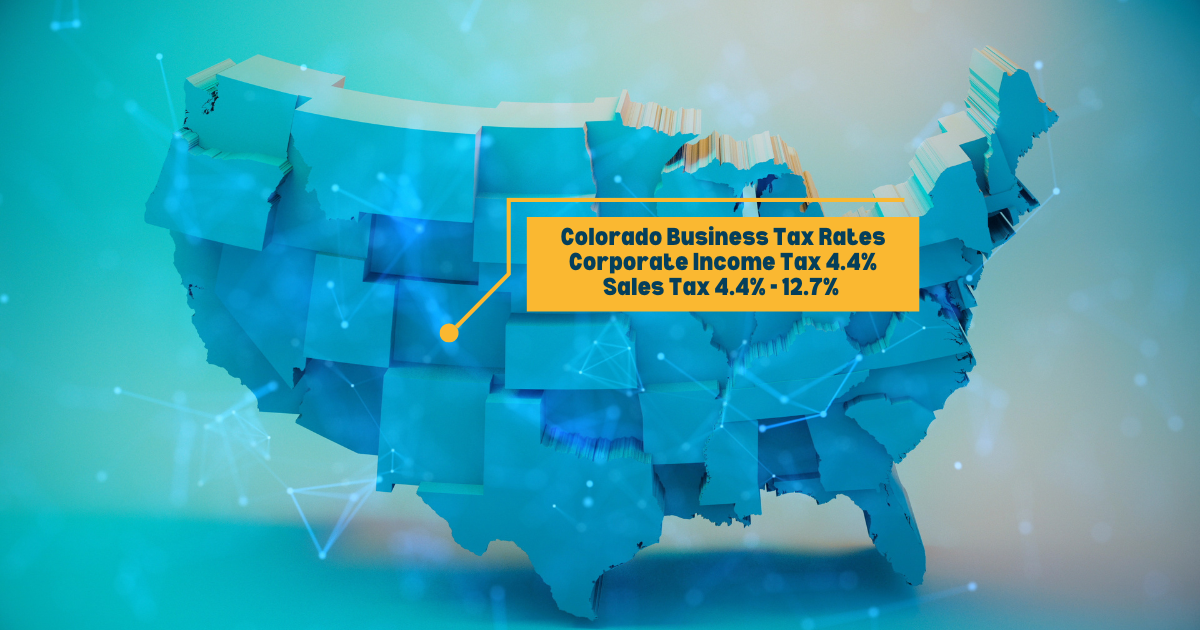
Navigating Colorado business tax can be complex. With a straightforward approach, this guide will explain the Colorado corporate tax rate, use tax responsibilities, sales tax obligations, and nexus criteria that could impact your business in 2024. It’s a practical resource tailored for entrepreneurs and business owners seeking to demystify the state tax code.
Key Takeaways
Colorado’s business tax includes a flat corporate income tax rate of 4.55%, a use tax addressing out-of-state purchases, and various tax credits such as the R&D and Enterprise Zone Investment Tax Credits to minimize tax liability.
Business tax obligations vary by type; nexus can trigger sales tax collection responsibilities, with economic nexus being a consideration for remote sellers passing the $100,000 sales threshold in-state.
Colorado’s sales tax system requires businesses with tax nexus to register, collect, and remit sales tax, considering local tax nuances and adhering to different rules in home-rule cities.
Navigating Colorado’s Business Tax Landscape

Colorado’s business tax landscape is a terrain of corporate income taxes and use taxes, layered over federal taxes. This structure is designed to balance the tax burden between different types of businesses while preventing tax evasion, particularly through mechanisms like use tax for out-of-state purchases.
Gaining a grasp on the interplay and applicability of these taxes to your business paves the way for effective tax planning and compliance.
Corporate Income Tax Essentials
In Colorado, the corporate income tax system is as follows:
The tax rate is a flat 4.55% on federal taxable income.
C corporations doing business in the state must file an annual state income tax return.
C corporations may need to make estimated tax payments quarterly.
The state offers various tax credits as incentives for businesses, such as the Research & Development (R&D) Tax Credit for qualified research and experimental expenditures.
Another beneficial credit is the Enterprise Zone Investment Tax Credit, which provides a 3% credit on equipment purchases to promote private business investment in economically distressed areas. These tax credits, among others, provide opportunities for businesses to minimize their tax liability.
Use Tax Responsibilities for Businesses
Colorado’s sales and use tax is a significant component of the state’s business tax structure, with the use tax specifically targeting items purchased out-of-state. Businesses are required to pay use tax on items purchased out-of-state that are used, stored, or consumed in Colorado if no sales tax was paid at the time of purchase. The use tax complements the sales tax and helps prevent tax evasion by ensuring a level playing field between in-state and out-of-state businesses.
Businesses must file their use tax returns electronically via Colorado.gov/RevenueOnline or by submitting a Consumer Use Tax Return form. Maintaining meticulous records of out-of-state purchases is key to accurately reporting and paying the corresponding use tax.
Understanding Tax Nexus in Colorado

The concept of nexus is integral to understanding Colorado’s business tax landscape. Nexus is the connection that triggers the requirement for businesses to collect income tax or sales tax in the state. It can be established through physical presence, such as having an office or warehouse in the state, or through economic activity within the state.
The implications of nexus extend beyond businesses with a physical presence in Colorado. Even remote sellers may be required to register and collect sales tax if they meet certain economic thresholds, thus establishing an economic nexus.
Physical Presence and Economic Thresholds
Physical nexus in Colorado is established by having a tangible presence such as an office, warehouse, or independent contractors operating within the state. On the other hand, economic nexus arises when a seller’s total sales within the state exceed $100,000 in either the previous or current calendar year.
Therefore, a remote seller must consider economic nexus in Colorado if their sales revenue from the state surpasses this threshold in the relevant period.
Special Tax Considerations for Different Business Types
The type of business structure you choose can significantly influence your tax obligations in Colorado. For instance, LLCs can opt to be taxed as a sole proprietorship, partnership, or corporation, providing flexibility in tax management. On the other hand, C corporations face ‘double taxation,’ where income is taxed at the corporate level and again upon distribution as dividends.
Additionally, insurance companies paying insurance premiums tax are exempt from income tax in Colorado. Understanding these special considerations can help you navigate tax planning and compliance more effectively.
Understanding Sales Tax Obligations

Understanding your sales tax obligations in Colorado requires determining if you have a sales tax nexus in the state. This determination is based on whether you sell tangible goods or services, act as a tax collector, and your business activities within the state. Once you determine the nexus, you are required to register with the state authority and undertake the process to collect Colorado sales tax, including the collection, filing, and remittance of sales tax to the state.
Keep in mind, neglecting to collect sales tax when mandated can saddle the business with the sales tax collected due along with any associated penalties and interest.
Remote Seller Considerations
The rise of e-commerce has led to new tax considerations for remote sellers. In Colorado, remote sellers are required to register for a sales tax permit if they meet or exceed certain economic thresholds. Once they establish a sales tax nexus, they must collect retailer’s use tax from their Colorado customers.
In jurisdictions like the City of Boulder, additional economic nexus standards have been implemented, requiring remote sellers exceeding certain sales thresholds to collect and remit sales tax.
Acquiring a Colorado Sales Tax License

Acquiring a sales tax license is a crucial step in managing your tax obligations in Colorado. The cost to apply for a sales tax license varies. For in-state sellers, it’s $16 plus a $50 deposit, while out-of-state sellers can apply for a Colorado Retailer’s Use Tax License for free.
There are also special event licenses for businesses selling at single or multiple special events.
The Application Process
You can apply for a Colorado Sales Tax License via MyBizColorado or by using the Sales Tax / Wage Withholding Account Application (CR 0100) for a single location. For businesses operating in multiple locations, the CR 0100 form is the requisite application form.
It’s worth noting that businesses intending to purchase items for resale without paying sales tax need to obtain a Colorado sales tax account/license through the CR 0100 form.
Maintaining Compliance
Upon acquiring your sales tax license, maintaining ongoing adherence to Colorado’s regulations is crucial. This includes:
Renewing your license every two years
Updating your account with any changes in mailing address, business location, or contact information
Filing a sales tax return even if there is no tax due for the reporting period.
Improper management of these obligations can lead to penalties and added stress, so it’s crucial to stay on top of them.
Local Sales Tax Nuances

Local sales tax can introduce additional complexities to the tax landscape in Colorado. The state houses over 70 home-rule cities, each with its own set of tax laws and regulations. Some cities, like Boulder, have implemented portals to aid remote sellers in complying with various sales tax regulations across jurisdictions.
While maneuvering through these subtleties can pose challenges, grasping them is indispensable for efficient tax management.
Home Rule Cities and Local Jurisdictions
Home-rule cities in Colorado have the power to self-administer their local sales and use taxes and establish their own regulations regarding taxable goods and services. This means that state-level exemptions may not necessarily apply at the local level, and businesses need to consider these local regulations when calculating their tax liabilities.
Both remote sellers and businesses with a physical presence in home-rule cities are subject to these local tax regulations.
Combined Sales Tax Rate Determination
The total sales tax rate in Colorado is determined by adding any local municipality taxes to the base state sales tax rate of 2.9%. Consequently, businesses in Colorado may encounter total sales tax rates of up to 11.2%.
For accurate determination of the combined sales tax rate, businesses should consult the Colorado sales tax guide, also known as the Colorado Sales/Use Tax Rates Publication (DR 1002), updated every six months.
Taxable Transactions and Exemptions
Spotting taxable transactions and exemptions forms a crucial part of managing your tax obligations. In Colorado, retail taxable sales of tangible personal property, as well as specific services, are subject to sales tax, while most services are not. However, there are certain transactions, such as shipping charges, that may be subject to sales tax under specific conditions.
Moreover, a mixed transaction that includes both tangible personal property and a service can also be fully taxable if it does not meet certain conditions exempting it from sales tax.
Defining Taxable Goods and Services
Sales tax in Colorado generally applies to tangible personal property sold at retail, while most services are not taxed. This means that if you’re a service enterprise, you’re typically considered a consumer of the tangible personal property you use in providing your services and must pay sales tax when purchasing such property. But, there are exceptions.
For instance, services that are taxable under Colorado law include gas and electric service for commercial use and intrastate telephone services.
Recognizing Exempt Sales
While most tangible personal property sold at retail is subject to sales tax in Colorado, there are exceptions. Certain items, such as residential energy usage and prescription medicine, are exempt from state sales tax. Other exemptions include gasoline, dyed diesel, and other exempt fuels, as well as certain agricultural sales, including farm and dairy equipment. It’s vital to recognize these exemptions when calculating your tax liability.
Service-Based Businesses
As mentioned earlier, services in Colorado are generally not taxable unless they are specifically taxed by law or provided as part of a transaction involving the sale of tangible personal property. Services that are exclusively for labor and not tied to tangible personal property are deductible from Colorado sales tax.
However, services that are taxable under Colorado law include gas and electric service for commercial consumption and intrastate telephone and telegraph services.
E-commerce and Digital Goods
As for digital goods, such as video, music, or electronic books that are delivered or stored by digital means, they are considered tangible personal property and are subject to Colorado sales tax. The method of delivery, whether through electronic download or internet streaming, does not affect their taxability.
However, sales of computer software that is not delivered on a tangible medium are exempt from Colorado state sales tax.
Filing and Paying Colorado Business Taxes
After ascertaining your tax liabilities, the subsequent step involves filing and paying your business taxes. Colorado sales tax returns are due based on the business’s assigned filing frequency, which can be monthly, quarterly, or annually. The specific due dates for Colorado sales tax return are the 20th of the month following the end of the collection period.
Filing a sales tax return late may lead to penalties and interest on the tax due. You can file and pay your taxes directly through the Colorado Department of Revenue’s Revenue Online portal or submit form DR-0100 via mail.
Filing Frequency and Deadlines
The frequency at which you must file sales tax returns in Colorado is determined by the volume of sales tax you collect. Here are the deadlines for each filing frequency:
Monthly filers: returns are due by the 20th day of the month following the reporting period
Quarterly filers: returns are due by the last day of the month following the end of the quarter
Annual filers: returns are due by January 20th of the year following the reporting year
Falling behind schedule can bring about penalties, so staying ahead of these dates is of utmost importance.
Online Filing Systems and Payment Options
The Colorado Department of Revenue provides several online systems for filing and paying your taxes. Their Revenue Online platform allows businesses to:
File and amend consumer use and sales tax returns
Make payments using electronic check
Make payments using credit card
Make payments using electronic funds transfer (EFT) for large tax liabilities.
For those who prefer not to file electronically, downloadable forms are available on the Department of Revenue’s website.
Handling Tax on Shipping and Delivery
A common question among businesses is whether shipping and delivery charges are subject to sales tax. In Colorado, shipping and handling charges are non-taxable when they meet two criteria: the charges must be separable from the purchase, and they must be listed separately on the invoice.
This means that if a seller allows a buyer to use the seller’s transportation service or an alternative, including the option for the buyer to pick up the goods themselves, these charges are considered separable and hence non-taxable.
Separately Stated Charges
Separately stated charges for shipping and handling on an invoice are one of the key criteria for these charges to be non-taxable in Colorado. In other words, if the delivery and freight charges are considered part of a service performed after the property is offered for sale and are separately stated on the customer invoice, they are not subject to state sales tax.
But remember, if the price of tangible personal property is not listed separately from labor or service charges on a single charge, the entire transaction is subject to sales tax.
Managing Sales Tax Exemption Certificates
Sales tax exemption certificates serve as indispensable tools for classifying purchases and customers exempt from sales tax, including government organizations and specific non-profits. These certificates are a key part of maintaining compliance, as each exempt transaction must be matched with a corresponding exemption certificate or be subject to retrospective taxation during an audit.
Improper use or fraudulent handling of sales tax exemption certificates can result in penalties, fines, or legal consequences.
Issuing and Accepting Exemption Certificates
Certain purchases made by entities like the federal government and charitable organizations, as well as school-related purchases by tax-exempt entities, are exempt from Colorado sales tax. These entities must use forms such as the revised DR 0715 for exempt entities, the DR 5002 for wholesale purchases, and the Multistate Tax Commission’s Uniform Sales & Use Tax Resale Certificate to document these exemptions.
It’s important to note that the Colorado Department of Revenue has streamlined exemption process requirements by eliminating several forms, making the process easier for taxpayers.
Recordkeeping and Validation
Maintaining accurate records and validating exemption certificates are imperative to guarantee compliance. Here are some key points to remember:
Records related to sales tax exemption certificates, including the certificates themselves and details of exempt transactions, must be securely stored and kept for a legally prescribed minimum period.
At the point of sale, a business must collect an exemption certificate from each customer claiming an exemption.
Immediately validate that all information on the certificate is correct and complete to avoid invalid certificates due to errors.
Effective management of sales tax exemption certificates involves tracking expiration dates and using automated systems to validate new certificates and to remind businesses to renew them.
Summary
Navigating Colorado’s business tax landscape might seem daunting, but with the right knowledge and tools, it doesn’t have to be. From understanding corporate income tax and use tax responsibilities to managing sales tax exemption certificates, this guide has provided a comprehensive overview of the key considerations for businesses operating in Colorado. With this knowledge at your fingertips, you’re well-equipped to confidently manage your business tax obligations and contribute to Colorado’s vibrant economy.
Frequently Asked Questions
What taxes do businesses pay in Colorado?
Businesses in Colorado pay a 4.40 percent corporate income tax rate and a 2.90 percent state sales tax rate, with the option for local jurisdictions to collect additional income taxes and sales taxes. This can result in a maximum local sales tax rate of 8.30 percent. An average combined state and local sales tax rate of 7.78 percent.
How are LLCs taxed in Colorado?
LLCs in Colorado are taxed at the flat income tax rate of 4.63% on profits, as they are considered pass-through entities, allowing owners to avoid double taxation.
What is the business use tax in Colorado?
The business use tax in Colorado is 2.9%. This tax applies to sales made outside one’s district and includes the Colorado state tax as well as any local district taxes.
Is Colorado a high tax state?
Colorado has a relatively low state sales tax rate and a flat income tax rate of 4.40%, making it not a high tax state overall. Additionally, the property taxes in Colorado are low.

Leave a Reply