
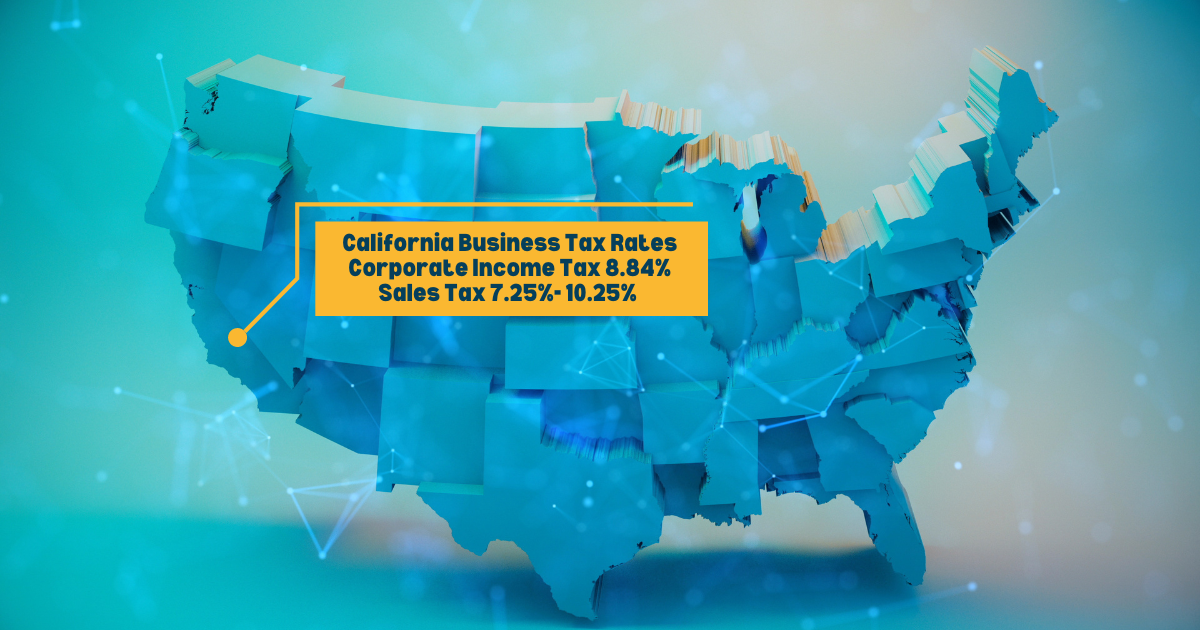
California, the A-list party state for business, has its own unique range of taxes, and we’re here to break it down for you. Businesses face corporate income taxes of 8.84%, with a due date on the 15th day of the 4th month after the taxable year closes. Don’t forget the $800 minimum franchise tax in the first quarter – it’s the entrance fee to the California party!
Enter the nexus realm, where a physical presence, employees making their mark, or significant economic moves can trigger state income tax obligations. When it comes to sales tax, California sets the baseline at 7.25%, but local variations can elevate it to a high-stepping 10.25%!
SaaS enjoys a tax exemption, but if you start dealing with tangible media, the tax spotlight might find you. California keeps a well-curated list of who’s invited to the sales tax party and who’s excused. Plus, there’s a tax credit gala for achievements like job creation, industry investments, and environmental stewardship!
What is the Corporate Income Tax Rate in California?
The corporate income tax rate for C corporations in California, excluding banks and financial institutions, is currently set at 8.84%.
Is There a Corporate Minimum Tax in California?
The minimum franchise tax of $800 is a mandatory payment due in the first quarter of each accounting period for corporations in California. This obligation persists regardless of the corporation’s activity level, whether it is active, inactive, operates at a loss, or files a return for a period less than 12 months. Notably, newly incorporated or qualified corporations are exempt from paying the minimum franchise tax during their initial year. Additionally, C corporations are exempt from the franchise tax for a tax year if two conditions are met: the tax year is 15 days or less, and the corporation did not engage in any business activities within California during these 15 days. It’s essential to highlight that any first-year net income remains subject to the 8.84% tax rate, even if the franchise tax is not applicable.
When is the California State Corporate Income Tax Return Due?
California’s filing deadline follows the Federal filing deadlines. The California corporate return is due the 15th day of the fourth month following the conclusion of the taxable year, typically meaning April 15th. Businesses seeking information on estimated payments can refer to the due dates for businesses listed on the Franchise Tax Board Website. It’s important to note that every corporation, whether incorporated, registered, or conducting business in California, is obligated to pay the minimum franchise tax amounting to $800.
How is State Income Tax Nexus Triggered?
In California, state income tax nexus is established when a business has a substantial connection or presence in the state, subjecting it to the state’s income tax obligations. Several factors can trigger nexus in California, including:
1. **Physical Presence:** Having a physical presence in the state, such as an office, store, warehouse, or employees, can establish nexus.
2. **Economic Presence:** California considers economic factors, such as a certain level of sales, revenue, or transactions within the state, to determine nexus. Economic nexus standards have become more prevalent, especially after the Supreme Court’s decision in the case of South Dakota v. Wayfair in 2018.
3. **Remote Employees:** Having employees working remotely from within California might trigger nexus, depending on the state’s regulations.
4. **Affiliate or Agent Nexus:** If a business has affiliates or agents operating in the state, this could create nexus.
5. **Ownership of Property:** Owning property in the state, such as a facility or office, may also contribute to the establishment of nexus.
Does Having an Employee or Contractor Trigger Nexus in California?
Yes, having an employee or contractor in California can trigger state income tax nexus. When a business has individuals working in the state, it establishes a connection that may subject the business to California state income tax obligations. This includes both employees and independent contractors, although constitutional limitations and certain exemptions may apply. Businesses should carefully assess their workforce and operations to determine whether they meet the criteria for establishing nexus in California and, if so, ensure compliance with the state’s income tax regulations and registration for employment tax purposes as well.
Are There State Income Tax Credits Available in California?
Yes, California offers various state income tax credits that businesses and individuals may be eligible for. These tax credits are designed to encourage specific activities, behaviors, or investments that the state government deems beneficial. Some common types of state income tax credits in California include:
1. **Research and Development Credit:** This credit aims to encourage businesses to engage in research and development activities within the state.
2. **Low-Income Housing Tax Credit:** Designed to promote the development of affordable housing, this credit provides incentives for investments in low-income housing projects.
3. **Enterprise Zone Hiring Credit:** Businesses that hire qualified employees from designated enterprise zones may be eligible for this credit.
4. **New Employment Credit:** Intended to stimulate job creation, this credit provides incentives for hiring qualified full-time employees.
5. **Film and Television Tax Credit:** California provides tax credits to encourage film and television production within the state, supporting the entertainment industry.
6. **Alternative Energy and Energy Efficiency Credits:** These credits are available for businesses investing in alternative energy sources and energy-efficient technologies.
7. **Disabled Access Credit:** Businesses that make accommodations for persons with disabilities may qualify for this credit.
It’s important for businesses and individuals to review the specific eligibility criteria and requirements for each credit, as they may vary.
City of Los Angeles Business Tax
Every individual conducting business activities within the City of Los Angeles must acquire the necessary Tax Registration Certificate(s) and fulfill the business tax requirements. The majority of business taxes are determined based on gross receipts.
For specific Business Tax Classifications, the tax rate is a designated amount per $1,000 of taxable gross receipts corresponding to each classification. Some business taxes are assessed at a flat rate per tax period, while others depend on factors such as the number of vehicles, machines, employees, square footage, seating capacity, or collected fees.
City of Los Angeles Business Tax Exemptions
There is a Small Business Exemption, effective from January 1, 2007, provides relief for small businesses with taxable and nontaxable gross receipts totaling $100,000 or less within and outside the City. Such businesses may qualify for an exemption. Additionally, there is a Business Tax
There also is an exemption for “Creative Artists” generating up to $300,000 in total taxable and non-taxable gross receipts linked to their qualifying “creative activities” for “entertainment or aesthetic purposes.” This exemption exclusively applies to individual “creative artists,” including individuals acting as corporations or operating through limited liability companies, and only covers gross receipts earned from their creative activities, excluding income from other sources.
City of Los Angeles Business Tax Due Date
Annual Business Taxes are due on January 1 of each year and are considered delinquent if not paid before March 1.
What is the California Sales Tax Rate?
The sales tax rate in California comprises a base rate of 6%, and an additional mandatory local rate of 1.25% allocated directly to city and county tax officials. The overall tax rate varies based on local sales tax jurisdictions and can reach a maximum of 10.25%.
How is Sales Tax Nexus Triggered?
In California, sales tax nexus is triggered by various factors related to a business’s activities within the state. Key criteria for establishing sales tax nexus include:
1. **Physical Presence:** A business has sales tax nexus in California if it has a physical presence, such as a brick-and-mortar store, office, warehouse, or employees working in the state.
2. **Economic Nexus:** California enforces economic nexus, meaning a business may have nexus based on its economic activity in the state, even without a physical presence. Economic nexus is often determined by the volume of sales or transactions conducted in California. Specific thresholds for economic nexus can vary and may change, so businesses need to stay informed about current regulations.
3. **Affiliate or Agent Nexus:** If a business has affiliates or agents operating in California, it might create nexus, depending on the nature and extent of their activities.
Businesses should regularly assess their activities and sales channels to determine if they have triggered sales tax nexus in California. Once nexus is established, the business is generally required to register with the state, collect sales tax on applicable transactions, and remit the collected tax to the California Department of Tax and Fee Administration (CDTFA).
What Transactions are Included or Excluded from Sales Tax?
In California, sales tax applies to a variety of transactions, and it’s important for businesses to understand what is included or excluded from sales tax. Here’s an overview:
**Included:**
1. **Retail Sales:** Sales of tangible personal property at retail are generally subject to sales tax.
2. **Services:** Some services are taxable, including amusement services, cable services, parking, and the repair of tangible personal property.
3. **Digital Goods:** Sales of digital goods, such as digital downloads of music, movies, and software, are usually taxable.
4. **Tangible Personal Property:** Sales involving tangible personal property are typically taxable in California.
5. **Leases and Rentals:** Leases and rentals of tangible personal property are subject to sales tax.
**Excluded:**
1. **Groceries:** Sales of most food products for human consumption are generally exempt from California sales tax
2. **Prescription Medications:** Sales of prescription medications are generally exempt.
3. **Sales Through Certain Marketplaces:** Sales made through a registered marketplace facilitator may be excluded from sales tax responsibility for individual sellers.
4. **Agricultural and Construction Items:** Certain agricultural and construction materials sold in California are exempted from sales tax.
Businesses should be aware of these distinctions to ensure proper compliance with California’s sales tax regulations.
Are Services Taxed for Sales Tax?
Only certain services are subject to sales tax in California. While California generally imposes sales tax on the sale of tangible personal property, it also extends taxation to specific services. Taxable services include, but may not be limited to:
1. **Amusement Services:** Charges for admission to places of amusement, including theaters, sports events, and amusement parks.
2. **Cable Services:** Charges for video programming services, including cable television services.
3. **Parking Services:** Charges for parking a vehicle in a parking lot or garage.
4. **Repair Services:** Charges for repairing tangible personal property, such as electronics or appliances.
Please note that service taxability can be complex, and there may be exceptions, so businesses should consult with a tax professional to ensure compliance with California’s sales tax laws.
Is SaaS Taxable for Sales Tax?
In California, the taxation of Software as a Service (SaaS) follows specific guidelines. Generally, California does not require sales tax on SaaS, as software accessed remotely over the internet without involving the customer receiving a physical copy or taking possession or control of the software is not considered tangible personal property. The absence of tangible media transfer to the customer makes the sale non-taxable. Electronic transfers of software or information are also exempt from sales tax.
SaaS businesses falling within this definition must adhere to California tax rules. SaaS is not classified as tangible personal property in California. For more information on why California exempts SaaS from sales tax, one can refer to CA Rev. & Tax Code Sec. 6016, which defines tangible personal property, and CA BTLG Reg. 1502, addressing the sale and lease of computer software and data processing services.
Regarding sales taxes on digital products in California, the state typically doesn’t charge sales tax on them. However, certain situations, such as bundling a digital product with a physical one like a CD-Rom, may subject the product to tax.
California does not require sales tax on downloadable prewritten software. The state’s definition of prewritten software programs includes those created for general sale or lease, encompassing programs initially developed for in-house use and later offered for sale or lease as a product. If transferred via remote telecommunications (such as the internet) from the seller’s business location to the purchaser’s computer without involving tangible personal property possession, it is considered non-taxable. This exemption also applies if the seller installs the software on the customer’s computer without transferring possession of any storage media during the transaction.

Leave a Reply