
Florida’s business tax landscape offers a favorable environment for entrepreneurs and corporations alike. The state stands out for its absence of a personal income tax, providing a unique advantage for businesses and residents. However, businesses in Florida encounter other tax obligations, including corporate income tax, sales tax, and property tax. Navigating these tax requirements is essential for maintaining compliance and optimizing financial strategies. This summary provides an overview of the key aspects of business taxation in Florida, offering insights into the state’s tax structure and considerations for businesses operating within its borders.
What is the Florida Corporate Income Tax Rate?
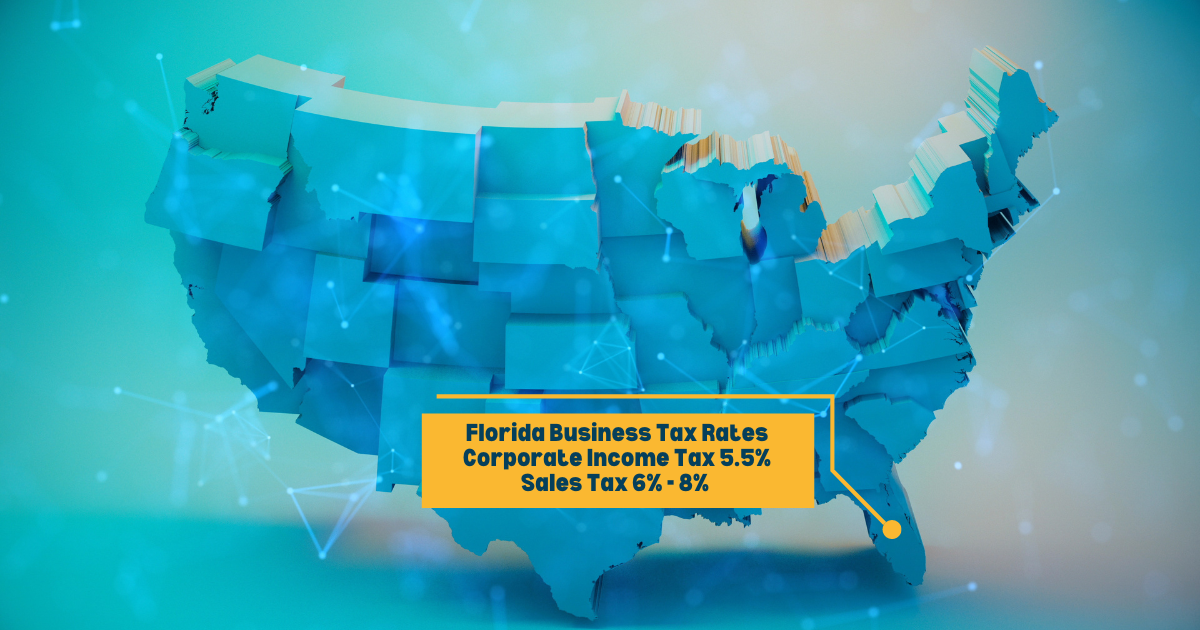
While many people think Florida is completely an income tax-free state, that is not the case. In Florida, state income taxes are solely applicable to traditional corporations, specifically C corporations. Corporations operating in Florida face a 5.5% income tax, with an initial exemption for the first $50,000 in income. This rate had gone down to 4.4% and 3.5% during the pandemic year, but has gone back up to 5.5%.
Corporations, including those federally classified as such, are liable for the tax. The corporation’s federal income, modified by Florida additions, subtractions, and adjustments, undergoes apportionment to Florida. This apportionment is determined by evaluating the corporation’s activities in Florida relative to its overall activities, typically involving factors like property, payroll, and sales.
However, limited liability companies (LLCs), sole proprietorships, and S corporations are exempt from the obligation to pay state income tax in Florida. However, if an LLC has elected to be taxed as a C-Corporation at the Federal level, it will be taxable in Florida.
Is There a Corporate Minimum Tax?
No, Florida does not currently have a corporate minimum tax. Corporate income tax filings in Florida are processed using the Florida Corporate Income/Franchise Tax Return, specifically Florida Form F-1120. But even though there is not a minimum tax, Corporations are required to submit this form annually, even if they have no tax liability.
When is the State Corporate Income Tax Return Due?
The deadline for filing is contingent on the corporation’s tax year. The filing deadline is the 15th day following the due date, without extension, for the related federal return for the taxable year. For instance, a taxpayer with a taxable year ending on December 31, 2016, would need to submit Florida Form F-1120 by May 1, 2017.
Late submissions incur penalties, with a 10% charge on any unpaid tax due each month or fraction thereof the return is overdue, not exceeding a total penalty of 50% of the unpaid tax. If no tax is owed, the penalty for a tardy filed return is $50 per month or fraction thereof, capped at $300. Interest rates, subject to change, are applicable to underpayments and late payments, and the current rates can be accessed on the Department’s Tax and Interest Rates webpage.
How is State Income Tax Nexus Triggered in Florida?
Despite your business being located outside of Florida, you might still need to register or file taxes in the state. Instances that establish a business connection, known as nexus, in Florida include, but are not restricted to:
Employing individuals, agents, or independent contractors engaged in sales or other business activities within Florida.
- Having an office or another place of business maintained in Florida.
- Engaging in the assembly, installation, service, or repair of products within Florida.
- Possessing, renting, or leasing real property or tangible personal property in Florida.
- Transporting goods to Florida customers using company-owned or leased trucks.
Does Having an Employee or Contractor Trigger Nexus?
Yes, having an employee or contractor in Florida can trigger nexus for a business. If a business has individuals working in the state, it establishes a connection that may subject the business to Florida state income tax obligations. This encompasses both employees and independent contractors, with considerations for constitutional limitations and specific exemptions that may be applicable.
Are There Florida State Income Tax Credits Available?
Florida has a number of income tax credits available for corporations, including:
The Experiential Learning Tax Credit Program incentivizes qualified businesses for employing apprentices, pre-apprentices, and student interns during taxable years within calendar years 2022-2025. The credit amounts to $2,000 per apprentice, pre-apprentice, or student intern, with a maximum annual credit of $10,000. $2.5 million is available each year, and the credit may be carried forward for up to two taxable years.
The Rural Job Tax Credit Program offers eligible businesses in designated rural counties an incentive for creating new jobs. The credit varies from $1,000 to $1,500 per qualified employee, with a maximum credit of $500,000 per calendar year. It can be carried forward for five years.
The Urban High-Crime Area Job Tax Credit Program encourages eligible businesses in designated urban areas to create new jobs, offering credits ranging from $500 to $2,000 per qualified employee. The credit can be carried forward for five years.
The Subtraction for Florida Employees Included in Calculation of Federal Employment Credits provides a deduction for wages and salaries paid to Florida employees, not deductible under Section 280C(a) of the Internal Revenue Code.
The Capital Investment Tax Credit benefits businesses in high-impact sectors, offering a credit for qualifying projects with a cumulative capital investment of at least $25 million. The credit may be claimed annually for up to 20 years.
The Community Contribution Tax Credit allows a 50% credit for qualified community contributions, with an annual limit of $200,000 per business. It can be carried over for five years.
The Contaminated Site Rehabilitation Tax Credit supports the rehabilitation of brownfield sites, providing a credit of 50% of rehabilitation costs, up to $500,000 per site per year. It may be carried forward for five years.
The Live Local Program Tax Credit enables contributions to the Florida Housing Finance Corporation, receiving a dollar-for-dollar credit against corporate income tax or insurance premium tax.
The New Markets Tax Credit allows a credit equal to 39% of the purchase price of a qualified investment, with a carryforward of up to five years.
The Research and Development Tax Credit supports eligible businesses with a credit for qualified research expenses. The credit may not exceed 50% of the Florida corporate income tax liability.
The Scholarship-Funding Organizations Tax Credits enables private contributions to nonprofit scholarship-funding organizations, receiving a dollar-for-dollar credit against specific Florida taxes, including corporate income tax.
The State Housing Tax Credit benefits private corporations building low-income housing projects in urban areas, allowing a credit of up to 9% of the eligible basis for each year of the credit period.
The Strong Families Tax Credit permits contributions to eligible charitable organizations, receiving a dollar-for-dollar credit against specific Florida taxes, including corporate income tax.
The Florida Alternative Minimum Tax Credit is available for the excess of Florida AMT paid over regular corporate income tax, with no time limit on carryovers.
What is the Florida Sales Tax Rate?
The prevailing sales tax rate in Florida (FL) stands at 6%, but the total rate can escalate to 8% based on varying city, county, and local tax jurisdictions.
How is Sales Tax Nexus Triggered in Florida?
In Florida, all vendors dealing in tangible property or goods, including leases, licenses, and rentals, must register with the state, file, and remit sales tax. For online filing and remittance, approved vendors like Returns for Small Business can be utilized, or businesses may opt to enroll in the e-Services program to independently manage payment deadlines.
Remote sellers utilizing Fulfillment by Amazon warehouses in Florida are deemed to have established nexus and are obligated to collect and remit sales tax.
What Transactions are Included or Excluded from Sales Tax?
In Florida, sales tax is imposed on the sale of tangible personal property and certain enumerated services. Here’s an overview of transactions that are included or excluded from sales tax:
Included in Sales Tax:
1. Sales of Tangible Personal Property: This includes the retail sale, lease, or rental of tangible personal property. Examples include selling goods like clothing, electronics, furniture, and vehicles.
2. Services: Florida imposes sales tax on specific services, such as amusement and recreation services, non-residential cleaning services, and certain repair and maintenance services.
3. Short-Term Rentals of Living or Sleeping Accommodations: This includes hotels, motels, vacation rentals, and certain other accommodations for a duration of less than six months.
4. Admissions Charges: Charges for admission to events or venues, including movie theaters, amusement parks, and sporting events.
Excluded from Sales Tax:
1. Sales of Real Property: The sale of real property, such as land and buildings, is generally not subject to sales tax.
2. Most Food Products: Most food products for human consumption are exempt from sales tax. However, there are exceptions, and prepared foods, certain beverages, and dietary supplements may be taxable.
3. Prescription Drugs and Prosthetic Devices: Prescription drugs and certain prosthetic devices are exempt from sales tax.
4. Agricultural Products: Sales of agricultural products for agricultural purposes are generally exempt from sales tax.
5. Medical Services: Most medical services performed by licensed professionals are not subject to sales tax.
6. Educational Services: Educational services provided by qualifying institutions are generally exempt from sales tax.
7. Certain Nonprofit Organization Sales: Sales made by qualifying nonprofit organizations may be exempt.
Are Services Taxed for Sales Tax in Florida?
Generally services are not subject to sales tax in Florida. Florida imposes sales tax on specific services in addition to the taxation of tangible personal property. Some examples of taxable services in Florida include:
1. Amusement and Recreation Services: Charges for admission to various entertainment events or venues, such as theaters, concerts, and amusement parks
2. Non-Residential Cleaning Services: Services provided by non-residential cleaning establishments.
3. Certain Repair and Maintenance Services: Taxable repair and maintenance services include services for tangible personal property, such as motor vehicles and appliances.
4. Short-Term Rental of Living or Sleeping Accommodations: Sales tax is applied to charges for accommodations like hotels, motels, vacation rentals, and other short-term rentals.
It’s important to note that not all services are taxable, and there are exemptions for certain services. Examples of non-taxable services include most medical services, educational services provided by qualifying institutions, and services performed by nonprofit organizations in certain situations.
Is SaaS Taxable for Sales Tax in Florida?
Florida’s laws and regulations do not specifically address the taxation of Software-as-a-Service (SaaS). However, the Florida Department of Revenue has clarified that SaaS is not subject to sales tax through a Technical Assistance Advisement, which is akin to a Private Letter Ruling. According to Florida’s definition, software services provided to end-users via the Internet, telephony network, or private network on a rental, subscription, or services basis fall within the scope of SaaS.
In Technical Assistance Advisement 16A-014, Florida explicitly mentions that sales of subscriptions to software and cloud-computing services are exempt from Florida sales tax as long as the delivery is electronic, and no tangible product is involved in the transaction. Another Technical Assistance Advisement (14A19-001) specifies that information technology infrastructure designed for computing power or storage capacity, along with data transfer fees, are also exempt from sales tax.
For businesses offering Software-as-a-Service in Florida seeking further clarity on the taxability of their services, it is advisable to request a Technical Assistance Advisement from the Florida Department of Revenue.
Frequently Asked Questions (FAQs) about Florida Business Taxes:
1. Is Florida completely income tax-free for businesses?
No, while Florida is often considered income tax-free, it imposes a 5.5% corporate income tax specifically on C corporations. Other entities like LLCs, sole proprietorships, and S corporations are generally exempt.
2. What is the corporate income tax rate in Florida?
Florida’s corporate income tax rate is 5.5% for traditional C corporations. There is an initial exemption for the first $50,000 in income.
3. When is the state corporate income tax return due in Florida?
The filing deadline depends on the corporation’s tax year and is generally the 15th day following the due date, without extension, for the related federal return.
4. How is state income tax nexus triggered in Florida?
Nexus can be triggered by various factors, including employing individuals or contractors in Florida, having an office or place of business in the state, and possessing property or inventory in Florida.
5. Does having an employee or contractor in Florida trigger nexus?
Yes, having an employee or contractor in Florida can trigger nexus, potentially subjecting the business to Florida state income tax obligations.
6. What is the sales tax rate in Florida?
The sales tax rate in Florida is 6%, but it can reach up to 8% when factoring in local city, county, and jurisdictional taxes.
7. How is sales tax nexus triggered in Florida?
Vendors dealing in tangible property or goods must register for sales tax. Remote sellers using Fulfillment by Amazon warehouses in Florida are also considered to have established nexus.

Leave a Reply