
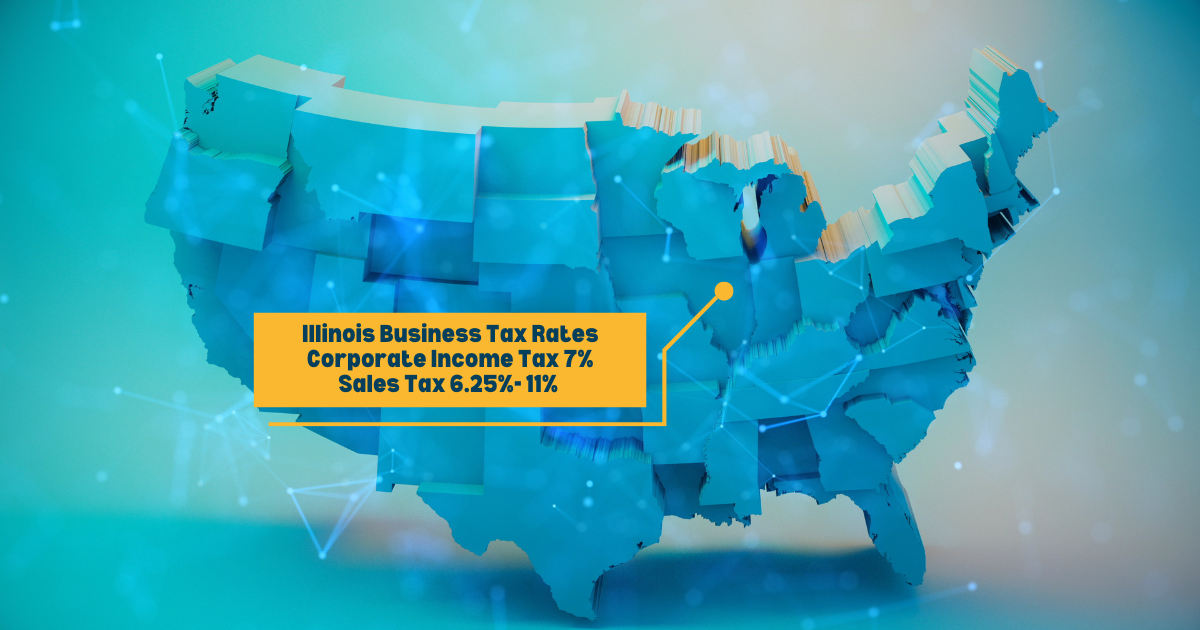
When it comes to Illinois business tax, knowing your rates, calculation methods, and filing deadlines is crucial for compliance and financial planning. This practical guide details the corporate income tax at a flat 7%, unpacks sales and special taxes, discusses use tax rules, and looks at property tax implications for businesses in Illinois. Equip yourself with key insights to manage your business tax efficiently.
Key Takeaways
Illinois businesses pay a flat corporate income tax rate of 7% on net income, with tax liability influenced by various deductions and credits, and the actual taxable income is based on federal adjusted gross income with designated state adjustments.
Sales tax in Illinois comprises a base rate of 6.25% for general merchandise with local variations that can total up to 11%, and certain transactions and items such as qualifying food, drugs, and medical appliances are exempt.
Businesses in Illinois must also be aware of special taxes like the state sales tax, the use tax on out-of-state sales, property tax based on assessed value, and individual income tax at a flat rate of 4.95% which impacts business owners and pass-through entities.
Navigating Illinois Corporate Income Tax

If you are a business owner, the corporate income tax is not a foreign term. As of now, the prevailing corporate income tax rate in the state of Illinois is a flat 7 percent of net income. This rate applies to all corporations, regardless of their size or industry. However, the actual tax liability is influenced by several factors, including deductions and credits that your business may qualify for.
Assessing the taxable income is a key aspect of the corporate income tax system. The taxable income for corporations in Illinois is determined by multiplying the net income by a flat rate, which is based on the federal adjusted gross income. Exemptions, such as the standard exemption permitted under Section 204, and deductions for net income can significantly reduce the tax liability.
Determining Taxable Income for Illinois Corporates
As a business owner, you might wonder what counts as taxable income. The taxable income for corporations in Illinois encompasses all income earned or received within the state, excluding retirement income. This income is subject to a flat tax rate, currently set at 7 percent for corporations.
Figuring out taxable income involves more than simply summing up your earnings. It involves a number of adjustments and deductions to better reflect the income subject to tax. Specific deductions available for corporations in Illinois are determined by federal taxable income and encompass ordinary and necessary business expenses. Additionally, adjustments to taxable income include addition adjustments for Illinois income and replacement tax liability, along with adjustments for interest, intangible expenses, and insurance premiums paid to affiliated companies.
Tax Credits and Incentives for Businesses
Tax credits and incentives can significantly reduce a business’s tax liability. Businesses in Illinois have the opportunity to utilize tax credits such as the Economic Development for a Growing Economy (EDGE) tax credit, which offers non-refundable annual tax credits against corporate income taxes for a period of up to 10 years.
In order to be eligible for these tax credits, Illinois businesses are required not only to maintain their workforce and create job opportunities, but also to utilize the state-provided incentives. The process of claiming and reporting tax credits involves applying for the credit and receiving the Certificate of Approval (CAC) electronically to their MyTax Illinois account.
Filing Requirements and Deadlines
All corporations in Illinois are obliged to file corporate income tax. Corporations, excluding S corporations, that anticipate an income and replacement tax liability exceeding $400 are required to make quarterly estimated tax payments. The deadline for filing the Illinois corporate income tax return is typically on or before April 15 of the subsequent year for a calendar-year corporation, or the 15th day of the 9th month following the close of the tax year for a cooperative corporation.
The process doesn’t end with filing the tax return. Paying the tax liability is equally important. Illinois provides several payment methods for settling corporate income tax, including making a payment through MyTax Illinois, using a check or money order, and paying online with a debit or credit card.
Sales Tax Essentials for Illinois Businesses

Sales tax also plays an essential role in the Illinois business tax system. As a business owner, you are required to collect sales tax on the sale of tangible personal property and certain services. The current sales tax rate in Illinois is 6.25% for general merchandise and 1% for qualifying food, drugs, and medical appliances.
Local sales tax rates in Illinois, which vary by region, are calculated by adding the state’s base rate to any extra taxes levied by local governments. Once collected, these taxes must be remitted to the state. Illinois businesses are required to electronically file the ST-1 form through MyTax Illinois to remit collected sales taxes.
Collecting Local Sales Tax Rates
The state of Illinois has a base local sales tax rate of 6.25%, but the actual tax rate can vary based on the municipality. The local sales tax rates can range from 0% to 4.75%, resulting in total sales tax rates ranging from 6.25% to 11% across different jurisdictions within the state.
Businesses in Illinois are obligated to collect and remit state and local retailers’ occupation tax at the origin rate, which consists of 6.25 percent on general merchandise and 1 percent on qualifying titled or registered items. Getting familiar with the local sales tax rate in your area is essential for accurate calculation and collection of the sales tax.
Exemptions and Non-Taxable Transactions
Not all transactions are subject to sales tax in Illinois. Non-taxable transactions under Illinois sales tax law include those that involve intangible personal property, such as shares of stocks, bonds, and evidences of debt.
Certain goods and services are also considered non-taxable. These include:
Qualifying food
Drugs
Medical appliances
Fuel for international flights
Gold bullion issued by qualified governments
To claim a sales tax exemption, businesses must provide evidence that the sale meets the criteria specified in the legislation. Being aware of these exemptions can assist businesses in preventing undue tax liabilities.
Special Taxes and Fees Applicable to Illinois Businesses

In addition to the corporate income tax and sales tax, businesses in Illinois may also need to comply with a range of special taxes and fees. These include:
6.25% state sales tax on general merchandise
1% tax on qualifying food, drugs, and medical appliances
Amusement Tax
Boat Mooring Tax
Automobile Lease Tax
Food & Beverage Tax
Hotel & Motel Tax
Home Rule Sales Tax
Local Motor Fuel Tax
Some businesses may also need to comply with the Illinois county public safety tax, also referred to as the Special County Retailers’ Occupation Tax. This tax is levied on businesses involved in the sale of tangible personal property, with the exception of items requiring titling or registration. Additionally, transportation and delivery charges within Illinois are subject to taxation if they are not separately itemized for the purchaser.
Understanding the County Public Safety and Facilities Taxes
The County Public Safety and Facilities Tax in Illinois, also known as the Special County Retailers’ Occupation Tax, is levied on businesses involved in the sale of tangible personal property, with the exception of items requiring titling or registration. This tax is enforced in conjunction with the state sales tax on relevant goods and the county school facility tax.
The tax rate for general merchandise is 6.25 percent, while items requiring titling or registration by an Illinois state agency are taxed at 1 percent. This tax affects businesses by levying an extra tax on their sales, which is specifically allocated for:
public safety
public facilities
mental health
substance abuse
transportation purposes
Transportation-Related Taxes for Businesses
Transportation-related taxes can also impact businesses operating in Illinois. For example, transportation and delivery charges within Illinois are subject to taxation if they are not separately itemized for the purchaser. Some counties also impose taxes by levying an extra tax rate of 0.75% on the total sales subject to the state sales tax.
Another example is the Illinois airline transportation tax, which is levied on the utilization of aircraft within the state. The tax rate stands at 6.25% of the selling price for each acquisition of aircraft that meets the criteria specified in the legislation. These taxes can significantly add to the overall tax burden of businesses, especially those in the transportation sector.
Unpacking the Illinois Use Tax for Businesses

Another tax that Illinois businesses need to be aware of is the use tax. In Illinois, the use tax is levied on the retail purchase of tangible personal property titled or registered with the State of Illinois and delivered to an address within Illinois. The prevailing rates for the Illinois Use Tax, as determined by the Illinois Department, are 6.25 percent on general merchandise and 1 percent on qualifying items.
Illinois businesses are required to collect this tax on items purchased for use within Illinois. If the seller does not collect a minimum of 6.25 percent sales tax, the purchaser bears the responsibility of paying the Use Tax. It’s important to note that marketplace facilitators are also responsible for the collection and remittance of tax on third-party sales commencing from January 1, 2020.
Marketplace Facilitators and Use Tax Collection
In the age of e-commerce, marketplace facilitators have become an important part of the tax collection process. In Illinois, a marketplace facilitator is defined as a person or entity that, through an agreement with third-party sellers, facilitates the sale of goods or services on a marketplace platform. They are responsible for collecting and remitting sales tax on behalf of the sellers.
Marketplace facilitators in Illinois must collect and remit use tax if they satisfy the tax remittance thresholds of $100,000 in sales of tangible personal property or 200 separate transactions for the sale of tangible personal. Understanding these obligations can help marketplace facilitators to comply with their tax responsibilities.
Use Tax Compliance for Out-of-State Sales
For businesses that operate across state lines, complying with use tax requirements for out-of-state sales is crucial. The use tax rate for out-of-state sales in Illinois is equivalent to the state sales tax rate, which stands at 6.25%. However, certain transactions, such as those involving intangible personal property, are considered non-taxable.
A business is required to collect tax, specifically use tax, on out-of-state sales in Illinois if it participates in selling activities that take place outside of Illinois. Understanding these requirements can help businesses avoid unnecessary tax liabilities and penalties.
Property Tax Considerations for Illinois Business Owners

Property tax is another significant consideration for Illinois businesses. Commercial properties in Illinois, such as office and retail buildings, are assessed at 25% of their value, as determined by the assessor on January 1 of each year. This means that the assessed value of a commercial property can greatly influence the total property tax liability.
The primary factors influencing business property tax rates in Illinois are the assessed value and fair market value of the property, as well as the income potential of the property. Comprehending these factors can enable businesses to precisely forecast their property tax liability and incorporate it into their budget.
Tangible Personal Property Tax Implications
In addition to real estate, businesses also need to be aware of the tax implications of owning tangible personal property. In Illinois, tangible personal property includes items such as:
clothing
vehicles
jewelry
business equipment
The tangible personal property tax is determined by the assessed value of the property that is not excluded or exempt from the tax base.
The Illinois tangible personal property tax is primarily imposed by local governments and overseen at the state level. It can affect the overall tax burden of a business by introducing an extra tax obligation determined by the value of the tangible personal property owned by the business. Being aware of this tax can facilitate businesses in precisely figuring out their tax liability and budgeting for it.
Property Tax Exemptions and Relief Programs
To help alleviate the property tax burden, Illinois offers several property tax exemptions and relief programs. These exemptions include properties used exclusively for charitable, educational, and governmental organizations, as well as properties used exclusively for religious purposes.
In order to qualify for these exemptions, a business must fill out the relevant application provided by the chief county assessment officer. The business must also be used exclusively for charitable, religious, educational, or governmental purposes.
In addition to these exemptions, Illinois also offers several property tax relief programs for Illinois residents, such as Homestead Exemptions, the Illinois Property Tax Credit, and tax incentives for property revitalization.
Individual Income Tax Impact on Business Owners
Individual income tax is another important consideration for business owners in Illinois. The individual income tax rate in Illinois, which stands at 4.95%, applies to business owners and has an impact on their business income. Additionally, for pass-through entities electing to be taxed, the rate is also 4.95%.
Besides paying income tax on their business income, business owners are also subject to specific filing obligations. Resident business owners in Illinois must file Form IL-1040 if they were required to file a federal income tax return or had Illinois income tax withheld, even if they were not required to file federally.
Taxation of Business Income for Individual Taxpayers
The process of taxing business income is contingent on the individual taxpayer’s situation. The business income of individual taxpayers in Illinois is subject to a flat tax rate of 4.95% of their net income.
For those who own a pass-through entity, each partner or shareholder is granted a credit against their own tax. Nonbusiness income received from the pass-through entity is considered as business income received directly by the partner or shareholder.
Self-employment income is also subject to taxation, with the self-employment tax rate for the tax year 2022-2023 set at 15.3%, comprising a 12.4% Social Security tax and a 2.9% Medicare tax.
Summary
Understanding the complex world of Illinois business tax can be a daunting task, but with the right information, it becomes manageable. Whether it’s the corporate income tax, sales tax, use tax, property tax, or individual income tax, all have unique features that business owners need to be aware of. By understanding these taxes and making use of the available credits, incentives, and exemptions, businesses can effectively manage their tax obligations and maximize their profits.
Frequently Asked Questions
How much do small businesses pay in taxes in Illinois?
Small businesses in Illinois pay a 7% corporate income tax on their net income to the Department of Revenue, as of 2021. This tax obligation is filed through Form IL-1120.
Do I need to pay business income tax in Illinois?
Yes, if you have a business in Illinois, you may need to pay personal property replacement tax based on your business’s net income. For traditional corporations, the tax is 2.5% of net income, while for other forms of business, the tax is 1.5% of net income.
What businesses are tax exempt in Illinois?
Exclusively charitable, religious, or educational organizations, governmental bodies, and certain other tax-exempt organizations are exempt from sales tax in Illinois. These organizations must obtain an IDOR-issued identification number to qualify for the exemption.
How is an LLC taxed in Illinois?
In Illinois, LLCs are taxed as pass-through entities, with profits or losses passing through to the members’ tax returns. Single-member LLCs are taxed as sole proprietorships, while multi-member LLCs are taxed as partnerships unless they elect for S corporation or C corporation taxation. It’s important to note the self-employment taxes and medicare contributions for each member, as well as the Illinois State Income Tax rate of 4.95%.
What is the corporate income tax rate in Illinois?
The corporate income tax rate in Illinois is a flat 7 percent of net income, making it an important factor to consider for businesses operating in the state.

Leave a Reply