
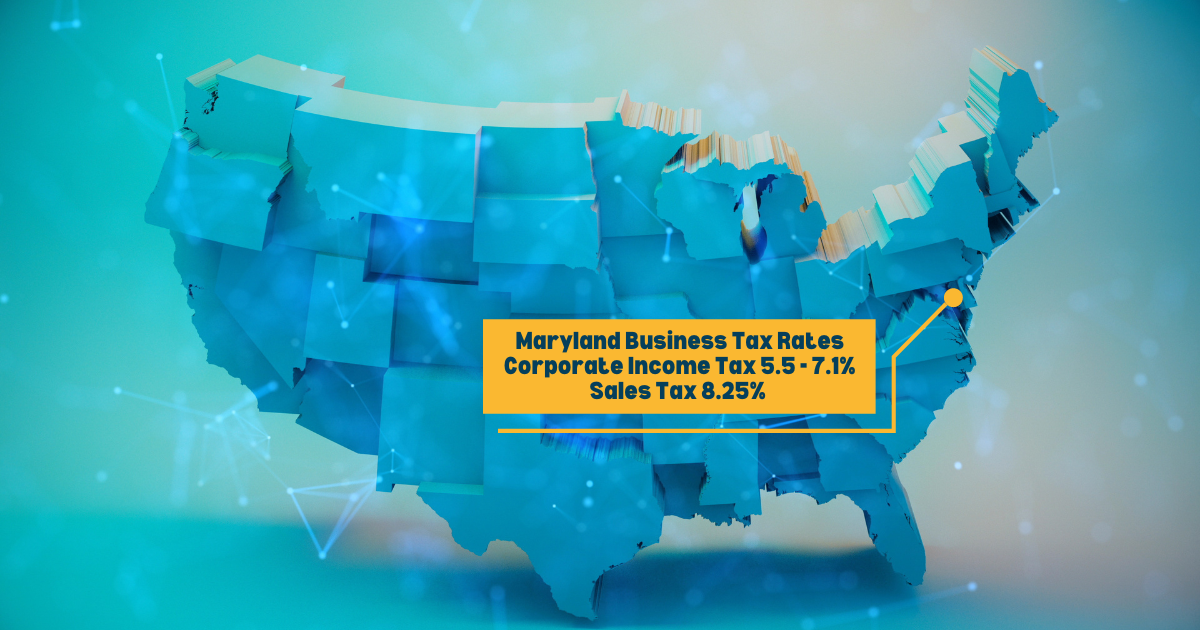
Navigating Maryland’s tax landscape involves understanding key elements of corporate income tax, pass-through entity filings, sales tax regulations, and recent changes impacting the taxation of digital products. With an 8.25% corporate income tax rate and a diverse array of tax credits, Maryland aims to foster economic development.
The state’s sales tax, set at 6.00%, comes with specific nexus triggers and inclusions/exclusions for various transactions. Recent legislation in 2022 exempted software-as-a-service (SaaS) from sales tax, providing clarity on taxation for enterprise-level computer software. This overview provides a glimpse into Maryland’s taxation framework, highlighting essential aspects for businesses operating within the state.
What is the Maryland Corporate Income Tax Rate?
The Maryland tax rate stands at 8.25%, applied to the Maryland taxable income, defined as Maryland modified income. This modified income is derived from adjusting the corporation’s federal taxable income with state-specific modifications. For corporations involved in operations spanning multiple states, the allocation of Maryland modified income is accomplished through an apportionment formula, typically incorporating factors such as receipts, property, and payroll.
Is There a Corporate Minimum Tax in Maryland?
There is no corporate minimum tax, but all Maryland corporations must file a tax return annually, irrespective of whether they possess taxable income or are currently inactive. Additionally, any other corporation falling under Maryland income tax jurisdiction, with income or losses linked to Maryland sources, is required to submit Form 500.
When is the Maryland Corporate Income Tax Return Due?
The deadline for filing Maryland Form 500 is the 15th day of the fourth month after the conclusion of the taxable year or period, meaning April 15th for calendar year filers. This aligns with the original due date for filing the federal return. Entities, including corporations and organizations, eligible for extended due dates for federal returns as per the Internal Revenue Code are granted the same extended due date for filing Maryland income tax returns.
Pass-Through Entity Income Tax
Maryland Form 510, the Pass-Through Entity Income Tax Return, is a mandatory filing for pass-through entities established or incorporated in Maryland, conducting business within the state, or possessing Maryland-sourced income (or losses). This requirement encompasses entities falling under various categories, including partnerships and Limited Liability Companies (LLCs) classified as partnerships, S corporations, and business trusts.
Form 510 serves as the mechanism for a pass-through entity to report crucial information such as income, adjustments, gains, losses, and other pertinent details. These elements are then passed through to the partners, shareholders, members, or beneficiaries (collectively referred to as “members”), who are individually responsible for filing the applicable Maryland income tax return. Each member is obligated to pay any applicable tax on their distributable or pro-rata share of the pass-through entity’s items for the respective tax year. It’s important to note that the submission of Form 510 does not require payment of Maryland income tax unless the pass-through entity is subject to the nonresident member tax.
Nonresident Member Income Tax
In cases where a pass-through entity possesses a nonresident member with nonresident taxable income, it becomes subject to Maryland income tax. This tax obligation is applied to the nonresident taxable income, calculated as the aggregate of the nonresident members’ distributive or pro-rata shares of the pass-through entity’s income that is allocable to Maryland.
The term “nonresident member” encompasses both nonresident individual members, defined as individuals or fiduciaries, and nonresident entity members. Nonresident entity members include corporations or pass-through entities that are not qualified or registered with the Maryland Department of Assessments and Taxation for business in Maryland or are not formed under Maryland law.
Pass-through entities should use Form 510C to submit a composite income tax return on behalf of nonresident individual members.
How is State Income Tax Nexus Triggered?
The Maryland corporation income tax is applicable to every Maryland corporation and any other corporation establishing nexus with the state. Nexus denotes a taxable connection between a corporation and the relevant taxing authority. If a corporation engages in business activities within Maryland aside from the constitutional salesperson exceptions, it establishes nexus and is obligated to file a corporation income tax return, utilizing Form 500.
Various in-state activities are considered to create nexus. These activities include maintaining a business location, owning or using property, employing individuals for solicitation and order acceptance, product installation or assembly, inventory storage, salesperson collections, technical assistance and training, corporate personnel engagement in repairs or replacements, and mobile stores (e.g., trucks with driver-salesmen) facilitating direct sales. For further details, refer to Administrative Release No. 2.
Does Having an Employee or Contractor Trigger Nexus?
In Maryland, having an employee or contractor may trigger nexus for income tax purposes, depending on certain activities conducted within the state. Having an employee or contractor doing the following activities that may trigger nexus in Maryland include:
- Maintaining a Business Location: If a business maintains an office, salesroom, warehouse, or any other place for the sale of tangible personal property or services in Maryland, it may establish nexus.
- Ownership or Use of Property: Owning or using property in Maryland, whether real or personal, for business purposes may create nexus. This includes rented office space or equipment used in the manufacturing and distribution of goods.
- Employees Soliciting and Accepting Orders: If employees regularly solicit and accept orders in Maryland, it could establish nexus for the business.
- Installation or Assembly of Products: Activities involving the installation or assembly of a corporation’s products in Maryland may trigger nexus.
- Maintaining a Stock of Inventory: Storing inventory in a public warehouse or placing it in the hands of a distributor or non-employee representative in Maryland may create nexus.
- Salespersons Making Collections: If salespersons regularly make collections on regular or delinquent accounts in Maryland, nexus may be established.
- Technical Assistance and Training: Providing technical assistance and training in Maryland after the sale of products may contribute to establishing nexus.
- Mobile Stores: Operating mobile stores in Maryland, such as trucks with driver-salesmen, from which direct sales are made, could establish nexus.
Are There Maryland Income Tax Credits Available?
Maryland offers various corporate income tax credits to eligible businesses. These credits are designed to encourage specific activities or investments that contribute to the state’s economic development. Some common corporate income tax credits in Maryland include:
- Research and Development Tax Credit: This credit aims to promote innovation by providing incentives for businesses engaged in qualified research and development activities.
- Biotechnology Investment Incentive Tax Credit: Geared towards the biotechnology industry, this credit encourages investment in qualified Maryland biotechnology companies.
- One Maryland Economic Development Tax Credits: This credit supports businesses that create jobs and make capital investments in economically distressed areas designated as “One Maryland” zones.
- Job Creation Tax Credit: Intended to stimulate job growth, this credit is available to businesses that create new, full-time positions in Maryland.
- Heritage Structure Rehabilitation Tax Credit: Businesses investing in the rehabilitation of certified heritage structures may qualify for this credit, promoting the preservation of historic properties.
- Sustainable Communities Tax Credit: Aimed at supporting sustainable development, this credit is available to businesses investing in projects located within designated Sustainable Communities.
- Film Production Activity Tax Credit: The film industry can benefit from this credit, which encourages film production activities within the state.
- Maryland Cybersecurity Investment Incentive Tax Credit: Focused on the cybersecurity sector, this credit incentivizes investments in qualified Maryland cybersecurity companies.
- More Jobs for Marylanders Tax Credit: Designed to encourage job creation, this credit supports businesses that establish new facilities or expand existing facilities in the state.
- Environmental Tax Credits: Various credits are available to businesses engaged in environmentally friendly activities, such as recycling, renewable energy, and pollution control.
- Enterprise Zone Tax Credits: Businesses operating in designated enterprise zones may be eligible for multiple tax credits, including property tax credits and income tax credits.
What is the Maryland Sales Tax Rate?
Maryland imposes a 6.00 percent state sales tax rate and does not apply any local sales taxes.
How is Sales Tax Nexus Triggered in Maryland?
Under Maryland law, individuals engaging in the business of an out-of-state vendor must register with the Maryland Comptroller, collect and remit sales and use tax, and file corresponding returns. This obligation arises when a person:
Permanently or temporarily maintains a place for selling tangible personal property or taxable services in Maryland, either directly or through an agent.
Utilizes agents, canvassers, representatives, salesmen, or solicitors in the state for delivering, selling, or taking orders.
Enters the state regularly to provide service or repair for tangible personal property.
Routinely uses vehicles to sell or deliver tangible personal property or taxable services in Maryland.
Sells tangible personal property or taxable services for delivery in Maryland, meeting specific revenue or transaction thresholds.
The Comptroller’s Office interprets the law broadly and considers services or repairs for tangible personal property as part of regular business activities. There is no minimum service or repair visits required, and the determination is based on the vendor’s policy and actual practices. Relevant information, including advertising materials, websites, and business documents, is examined in assessing whether a person engages in the business of an out-of-state vendor.
For sales of tangible personal property or taxable services into Maryland, nexus requirements became effective on October 1, 2018. Out-of-state vendors surpassing $100,000 in sales or conducting at least 200 separate transactions into Maryland must register and collect sales tax. Guidance for registration and compliance is provided by the Comptroller’s Office, and one-time event participants may acquire a Temporary Sales & Use Tax License. If nexus is no longer applicable, vendors can close their Maryland sales and use tax account.
What Transactions are Included or Excluded from Sales Tax?
In Maryland, sales tax applies to various transactions involving the sale of tangible personal property, products transferred electronically, or taxable services. Here are notable inclusions and exclusions:
Included Transactions:
- Tangible Personal Property Sales: Sales of tangible and movable goods, such as electronics, clothing, and furniture, are subject to Maryland sales tax.
- Taxable Services: Certain services, including repair and maintenance services, are also subject to Maryland sales tax. Examples include repair services for tangible personal property and specific professional services.
Excluded Transactions:
- Machinery for Manufacturing: Machinery intended for new or expanded industrial operations is exempt from Maryland sales tax.
- Raw Materials and Industrial Supplies: Items like raw materials, industrial supplies, and tools used in manufacturing are excluded.
- Items for Resale: Goods acquired for the purpose of resale are exempt from Maryland sales tax.
- Certified Pollution Control Equipment: Equipment certified for pollution control purposes is exempt from sales tax.
- Containers and Packaging: Materials used for packaging and containers are excluded from Maryland sales tax.
- Energy and Fuels for Energy Production: Energy and fuels used for energy production, exceeding 3 percent of the manufacturing cost, are exempt.
- Industrial Supplies and Tools in Manufacturing: Supplies and tools used in the manufacturing process performed on another entity’s property are excluded.
Are Services Taxed for Sales Tax?
Charges for services are typically exempt from Maryland sales and use tax unless specified as taxable under state law.
Taxable Services:
- Fabrication, printing, or production of tangible personal property by special order.
- Commercial cleaning or laundering for businesses with recurring service needs.
- Cleaning of commercial or industrial buildings.
- Cellular telephone and other mobile telecommunications services.
- Specific telephone services, such as pay-per-view television and credit reporting.
- Security services, including detective, guard, or armored car services, and security systems services.
- Transportation services for the delivery of electricity or natural gas, if subject to sales and use tax.
- Prepaid telephone calling arrangements.
- Privilege to consume non-purchased wine in certain establishments.
- Mandatory gratuities or service charges for serving food or beverages to groups exceeding 10 individuals.
Exempt Services:
- Delivery, freight, or transportation services directly to the buyer by the vendor or another acting for the vendor, unless the transportation service is taxable.
- Finance charges, interest, or similar charges for credit extended to the buyer.
- Labor or service for application or installation.
- Mandatory gratuities or service charges for serving food or beverage to groups of 10 or fewer individuals for on-premises consumption.
- Personal, professional, or insurance services not defined as taxable, involving inconsequential sales.
- Services for operating equipment used in audio, video, or film recording.
- Custom computer services.
- Fabrication, processing, or service by a sawmill for wood products used in mining where the miner retains title.
- Charges for labor to repair or alter existing tangible personal property for restoration purposes.
Is SaaS Taxable for Sales Tax?
Maryland passed a law in 2022 exempting software-as-a-service (SaaS) from sales tax. The amendment to the definition of “digital product” explicitly excludes enterprise-level computer software and SaaS from being taxed. Moreover, specific digital products are now exempt from taxation if the purchaser holds a copyright or intellectual interest and uses the product for commercial purposes.
In Maryland, the term “digital products” now explicitly excludes products with certain capabilities held by the purchaser for commercial use, as well as computer software or SaaS exclusively purchased for commercial purposes within an enterprise computer system, whether housed by the purchaser, the software vendor, or a third party. These amendments provide clarity and ensure that purchases related to enterprise-level software and similar service models for commercial use remain non-taxable under Maryland law.
However, Maryland designates the following as taxable digital products:
- Sale, subscription, or license to use a software application
- Sale, subscription, or license to access content online
- Prerecorded music, book readings, and speeches
- Digitized sound files downloadable onto a device for user alerts
- Digital downloads or streams of motion pictures, music videos, news and entertainment programs, live events, sporting events, tutorials, etc.
- Audio/video greeting cards sent via email
- Ring tones
- Movies, music videos, news and entertainment programs, live events, and video/electronic games
- E-books
- Newspapers, magazines, chat room discussions, and weblogs
- Digital codes exchanged for digital products
Frequently Asked Questions (FAQ’s) – Maryland Business Taxes
What is the corporate income tax rate in Maryland?
Maryland imposes an 8.25% corporate income tax rate on taxable income, with a unique formula for multi-state corporations to allocate income.
Is there a corporate minimum tax requirement in Maryland?
While there’s no corporate minimum tax, all Maryland corporations must file annual tax returns, even if they have no taxable income or are inactive.
When is the deadline for filing Maryland corporate income tax returns?
The deadline for filing Maryland Form 500 is the 15th day of the fourth month following the close of the taxable year, typically April 15th for calendar year filers.
What is the Pass-Through Entity Income Tax Return, and who needs to file it?
Pass-through entities operating in Maryland, such as partnerships and LLCs, must file Form 510 to report income, adjustments, and other details. Individual members then report their share of income on personal tax returns.
How is nonresident member income taxed in Maryland?
If a pass-through entity has a nonresident member with nonresident taxable income, it becomes subject to Maryland income tax. Form 510C is used for composite income tax returns on behalf of nonresident individual members.
What activities create nexus for Maryland corporate income tax?
Nexus is triggered if a corporation engages in activities like maintaining a business location, owning or using property, having employees soliciting orders, or conducting sales in Maryland.
Are there tax credits available for businesses in Maryland?
Yes, Maryland offers various corporate income tax credits, including incentives for research and development, biotechnology investment, job creation, heritage structure rehabilitation, and sustainable communities, among others.

Leave a Reply