
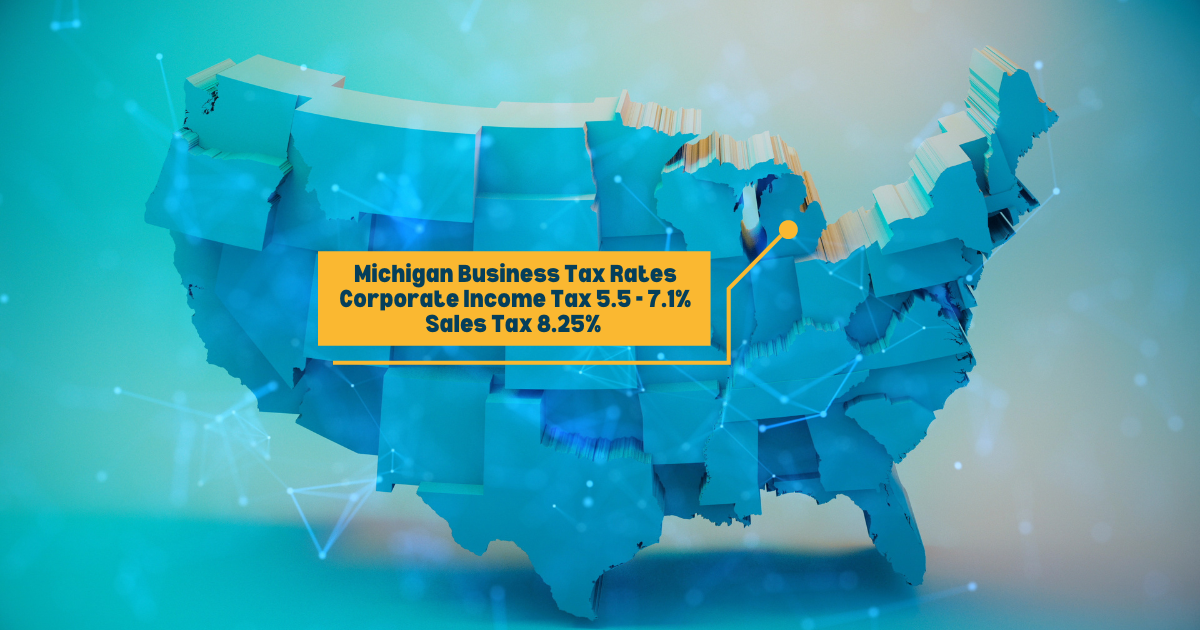
Navigating the intricate landscape of Michigan’s tax regulations is a crucial undertaking for businesses and individuals alike. This Midwestern state imposes a 6% corporate income tax on C corporations and entities taxed as corporations at the federal level, with distinct credits and exemptions. Sales tax, marked by a 6% state rate, follows specific guidelines for retailers, wholesalers, and contractors. Unraveling the complexities of Michigan’s tax system is paramount for compliance, making it imperative to delve into the details of corporate taxes, sales tax obligations, and the nuances that define tax nexus within the state.
What is the Michigan Corporate Income Tax Rate?
Michigan imposes a 6% corporate income tax on C corporations and entities taxed as corporations at the federal level. The Michigan Corporate Income Tax (CIT) features a single credit known as the small business alternative credit, allowing for an alternative tax rate of 1.8% on adjusted business income. Alternative tax structures apply to insurance companies and financial institutions.
Taxpayers with allocated or apportioned gross receipts below $350,000 and/or an annual liability equal to or less than $100 are exempt from filing or paying the CIT. However, this gross receipts threshold does not apply to financial institutions or insurance companies.
Is There a Corporate Minimum Tax in Michigan?
Michigan imposes a Corporate Minimum Tax (CMT) on corporations subject to the CIT. The CMT is applicable to corporations that have gross receipts greater than $350,000. It is important to note that the CMT is distinct from the CIT and is specifically tied to the MBT, which was the predecessor to the CIT.
For corporations subject to the MBT, the CMT is determined based on gross receipts. The minimum tax is calculated as follows:
- If gross receipts are between $350,000 and $599,999, the minimum tax is $150.
- If gross receipts are between $600,000 and $999,999, the minimum tax is $800.
- If gross receipts are $1 million or more, the minimum tax is $2,000.
When is the State Corporate Income Tax Return Due?
Michigan Annual Returns must be submitted by the final day of the 4th month after the tax year concludes, accompanied by the payment of the ultimate liability. Taxpayers, excluding Insurance Companies or Financial Institutions, are exempt from filing or paying if their apportioned gross receipts are below $350,000. The filing threshold is adjusted for tax years shorter than 12 months.
For those needing additional time, the Department may grant an extension to file, provided a timely application is submitted along with the payment of the tax owed. It’s important to note that an extension of time to file does not extend the deadline for tax payment.
If a federal extension is approved, the Department automatically extends the deadline to the last day of the 8th month following the return due date. To secure this extension, the taxpayer must submit Form 4, along with the federal extension request, and fulfill the tax liability by the due date to avoid penalties and interest.
How is State Income Tax Nexus Triggered?
A person establishes nexus with Michigan under the following conditions:
- Physical Presence: The person is physically present in the state for more than one day.
- Active Solicitation with Gross Receipts: The person actively solicits sales in Michigan and has gross receipts of $350,000 or more sourced to Michigan. The term “actively solicits” includes speech, conduct, or activity purposefully directed at or intended to reach individuals within Michigan, explicitly or implicitly inviting a purchase order. It also encompasses speech, conduct, or activity directed at individuals within the state that is ancillary to requests for a purchase or sale.
- Ownership or Beneficial Interest in a Flow-Through Entity: The person has an ownership or beneficial interest in a flow-through entity, directly or indirectly, which has substantial nexus in the state. A “flow-through entity” includes subchapter S corporations, general partnerships, trusts, limited partnerships, limited liability partnerships, or limited liability companies not taxed as corporations at the federal level.
Regarding apportionment, if a taxpayer’s business activities are limited to Michigan, the tax base is entirely allocated to the state. If business activities extend beyond the state, the tax base is apportioned using a 100% sales factor. Business activity is considered subject to tax outside the state if the taxpayer is subject to specific taxes or if the other state has jurisdiction to tax the taxpayer.
The sales factor is a fraction, with the numerator being total sales made in Michigan during the tax year and the denominator being total sales made by the taxpayer everywhere during the tax year.
For a taxpayer with an ownership or beneficial interest in a flow-through entity, the business income directly attributed to the flow-through entity’s activities is apportioned to Michigan using the entity’s sales factor.
In a unitary business group, “sales” include sales in Michigan of every person in the group, regardless of nexus. However, sales between group members are eliminated when calculating the sales factor. The definition of “sales” encompasses tangible and intangible property sales, services, and the lease, rental, licensing, or use of tangible or intangible property.
Please note that special sourcing rules apply to various services and activities, including securities brokerage, regulated investment companies, mortgages, transportation services, and telecommunications services.
Does Having an Employee or Contractor Trigger Nexus?
Yes, having an employee or contractor in Michigan can trigger nexus for a business. According to Michigan tax regulations, a person is considered to have nexus with the state if they are physically present in Michigan for more than one day. Therefore, the presence of employees or contractors conducting business activities in the state establishes a connection (nexus) that may subject the business to Michigan taxes.
It’s important to note that the general rule considers the presence of employees as indicative of doing business, but this is subject to constitutional principles. Mere physical presence, especially temporary presences such as during the COVID-19 pandemic, may not be the sole factor in determining nexus.
Are There Michigan Income Tax Credits Available?
Derived from the MBT, the Small Business Alternative Credit remains the sole credit within the CIT. It is applicable to any taxpayer, excluding insurance companies and financial institutions, whose gross receipts do not surpass $20,000,000.00, and whose adjusted business income (minus the loss adjustment) is not more than $1,300,000.00, annually adjusted for inflation and subject to specific disqualifiers. Disqualification occurs if an officer or shareholder receives compensation exceeding $180,000, or if the combined total of compensation and share of business income surpasses that threshold (allocated income disqualifier). In cases of partial disqualification, a taxpayer might still qualify for a reduced credit.
While a unitary business group may meet the criteria for the credit, any disqualifier or reduction percentage applies uniformly to the entire group if it affects any single member. The gross receipts and adjusted business income thresholds are determined at the group level. The allocated income disqualifier is computed for an officer or shareholder by considering all amounts paid or allocable to them by all members of the unitary business group. Reduction percentages, which can diminish but not entirely eliminate the credit, follow a similar calculation method.
Michigan Sales Tax Overview
Michigan stands out for its absence of city, local, or county sales tax, relying solely on a state sales tax rate of 6%. Understanding the nuances of sales tax obligations is crucial for different types of businesses:
Retailers:
Retailers, involved in direct sales to the end consumer, must remit a 6% sales tax on their retail transactions to the State of Michigan.
To facilitate this process, retailers are required to be licensed, allowing them to collect sales tax from customers and submit it to the state.
Wholesalers:
Wholesalers engage in sales to other wholesalers or retailers, not directly to the final consumer.
The classification of a wholesaler is determined by the entity to which they sell their products, not the selling price.
Wholesalers, who purchase items for resale at the wholesale level, are not involved in retail sales and, as such, are not obligated to register for sales tax.
Wholesalers claiming an exemption should furnish a written statement affirming that they are acquiring items for “resale at wholesale.”
Contractors:
Contractors or subcontractors are exempt from the sales tax license requirement since they are considered the ultimate consumers of the materials they use in real property construction.
Individuals engaged in activities like constructing, altering, repairing, or improving real estate for others bear the responsibility for sales tax on the inventory value of materials affixed to the property.
Nonprofit hospitals or nonprofit housing entities constructing, altering, repairing, or improving real estate are exempt from tax on materials affixed to and integrated into the hospital or housing entity’s structure.
For more detailed information, specific guidelines, and exemptions, businesses can refer to Revenue Administrative Bulletins 1988-35 and 1999-02.
How is Sales Tax Nexus Triggered in Michigan?
A remote seller establishes nexus with Michigan when its gross sales surpass $100,000 or when it conducts 200 or more transactions (inclusive of taxable, nontaxable, or exempt sales) into Michigan in the preceding calendar year.
Regarding the definition of a “transaction” for the purpose of the 200-transaction threshold:
- A single sales transaction is constituted by a singular order, irrespective of the number of items ordered concurrently and appearing on a unified invoice.
- Even if multiple payments are made for a single purchase, or a single order is dispatched in several separate shipments, it still qualifies as one transaction.
- An invoice encompassing items designated for delivery to multiple states is recognized as a transaction in Michigan if any of the items are destined for delivery into the state.
What Transactions are Included or Excluded from Sales Tax?
In Michigan, sales tax generally applies to retail sales of tangible personal property and certain services. Here’s an overview of what transactions are included or excluded from sales tax:
Included (Taxable):
- Tangible Personal Property: Most retail sales of tangible personal property are subject to sales tax. This includes items like electronics, furniture, clothing (if over a certain value), and other physical goods.
- Services that Create or Manufacture Products: Services that result in the creation or manufacturing of a product are generally taxable. For example, if a service involves creating a custom item for a customer, it may be subject to sales tax.
Excluded (Non-Taxable):
- Clothing under a Certain Value: Clothing items with a value below a specified threshold are generally exempt from sales tax.
- Most Non-Restaurant Food and Groceries: Sales of most food products for human consumption in grocery stores are not subject to sales tax. However, prepared meals from restaurants are taxable.
- Specific Healthcare and Sanitation Items: Certain healthcare and sanitation items may be exempt from sales tax. This can include items like prescription drugs, medical supplies, and hygiene products.
- Prescribed Medical Devices: Sales of prescribed medical devices are generally exempt from sales tax.
- Periodicals: Sales of newspapers and magazines are generally exempt from sales tax.
Are Services Taxed for Sales Tax?
In general, services are not taxed in Michigan. However, specific rules govern some service transactions in Michigan. Non-taxable service transactions include those where the primary focus is the service itself without any transfer of tangible personal property. Additionally, inconsequential transfers of property within service transactions may not be subject to sales tax if the property’s purchase price is not separately stated on the customer’s bill.
Is SaaS Taxable for Sales Tax?
In Michigan, Software-as-a-Service (SaaS) is not specifically defined as taxable. Instead, the state examines whether the software fits within its definition of “prewritten computer software,” which is subject to sales tax.
The following criteria determine taxable prewritten computer software:
Prewritten Computer Software includes computer software, often known as “canned” software, along with prewritten upgrades. It must be delivered by any means and not designed and developed to the specifications of a specific purchaser. Additionally, it encompasses:
- Any combination of two or more prewritten computer software programs or portions thereof.
- Computer software designed and developed to the specifications of a specific purchaser but sold to a person other than that specific purchaser.
- The modification or enhancement of prewritten computer software or portions thereof if designed and developed to the specifications of a specific purchaser. However, an exception exists if there is a reasonable, separately stated charge or if an invoice or other statement of the price is provided to the purchaser for the modification or enhancement. If someone other than the original author or creator modifies or enhances prewritten computer software, that person is considered the author or creator of only their modifications or enhancements.
Therefore, the taxability of SaaS in Michigan hinges on whether it falls within this definition of taxable prewritten computer software.
Frequently Asked Questions (FAQ’s) – Michigan Business Taxes
What is Michigan’s corporate income tax rate?
Michigan imposes a 6% corporate income tax on C corporations and entities taxed as corporations at the federal level. Certain credits and exemptions may apply, influencing the effective tax rate.
Are there any tax credits available for businesses in Michigan?
Yes, Michigan offers various tax credits, with the Small Business Alternative Credit being a notable one. This credit, retained from the Michigan Business Tax (MBT), provides an alternative tax rate for qualifying businesses.
How does Michigan determine sales tax for different business types?
Michigan has a state sales tax rate of 6%. Retailers selling directly to consumers must remit this tax, while wholesalers and contractors have specific guidelines determining their sales tax obligations. Understanding these distinctions is crucial for compliance.
What triggers nexus for income tax purposes in Michigan?
Nexus is triggered in Michigan if a person has a physical presence in the state for more than one day, actively solicits sales with gross receipts over $350,000, or has an ownership interest in a flow-through entity with substantial nexus in the state.
Is Software-as-a-Service (SaaS) taxable in Michigan?
Michigan does not specifically define SaaS as taxable. The taxability of SaaS hinges on whether it falls within the state’s definition of taxable prewritten computer software, which includes certain criteria for delivery and customization. Understanding these criteria is essential for businesses offering SaaS in Michigan.

Leave a Reply