
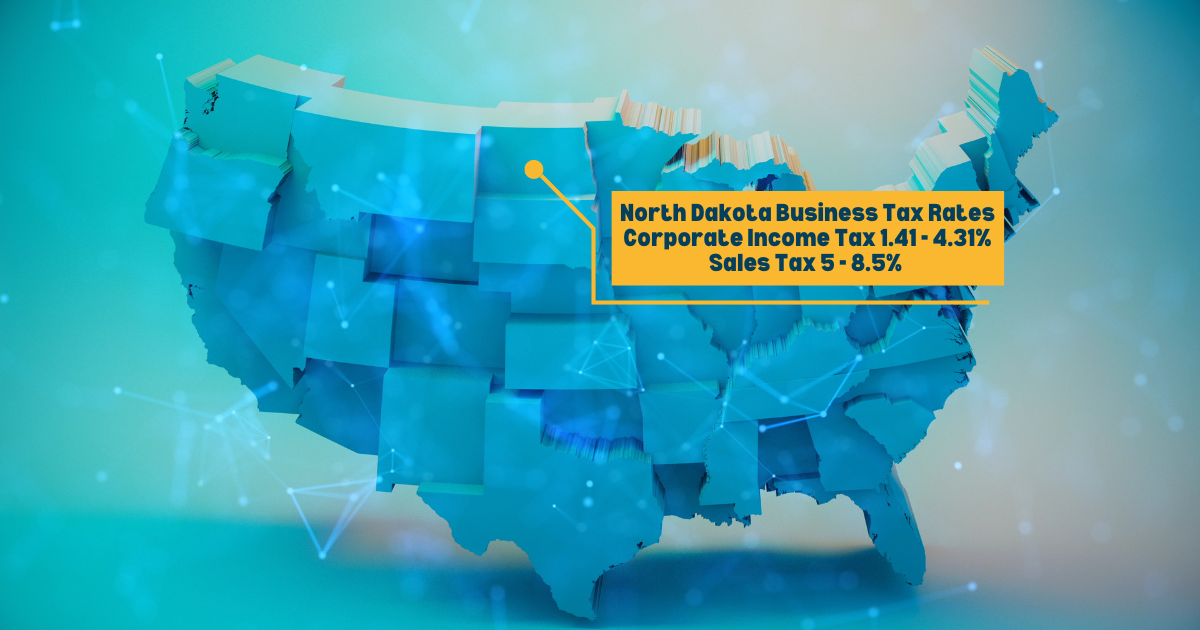
North Dakota’s tax landscape encompasses a variety of levies, including corporate income tax and sales tax, each playing a crucial role in funding the state’s operations and services. The state’s corporate income tax structure features a tiered rate system, ranging from 1.41% to 4.31%, with unique considerations for entities like partnerships and LLCs. North Dakota also extends various tax credits to incentivize research and development, investment, job creation, and contributions to specific sectors, contributing to the state’s economic growth.
Sales tax in North Dakota, set at a state rate of 5%, is augmented by potential local rates, creating a combined rate of up to 8.5%. The taxation scope extends to a diverse array of transactions, with specific guidelines outlining taxable and exempt items. Notably, the state employs economic and physical presence criteria to determine sales tax nexus, ensuring that businesses engaging in economic activities within North Dakota contribute their fair share.
What is the North Dakota Corporate Income Tax Rate?
North Dakota assesses corporate income tax rates range from 1.41% to 4.31% based on North Dakota taxable income. The computation of state income employs a three-factor apportionment formula with equal weighting. Notably, partnerships, S corporations, and LLCs are exempt from income tax at the entity level; instead, the entity’s profits or losses are transferred to the respective owners of the entity.
North Dakota corporate income tax rates follow a tiered structure:
- For income up to $25,000, the tax rate is 1.41% of North Dakota taxable income.
- In the income bracket of $25,000 to $50,000, the tax is $352.50 plus 3.55% of the amount exceeding $25,000.
- Beyond $50,000, the tax is $1,240 plus 4.31% of the amount exceeding $50,000.
Additionally, if a corporation opts for the water’s edge method for income apportionment, it becomes subject to an extra 3.5% surtax on its North Dakota taxable income.
When is the State Corporate Income Tax Return Due?
Every corporation conducting business in North Dakota or generating income from North Dakota sources is obligated to submit a Form 40 – Corporation Income Tax Return. The filing must include a signed Form 40 and, at a minimum, the initial 6 pages of the Federal 1120 along with pertinent schedules.
The deadline for filing this return is April 15 annually. An extension for filing your North Dakota corporate income tax return can be obtained by securing either a federal extension or a North Dakota extension.
How is North Dakota Income Tax Nexus Triggered?
North Dakota income tax Nexus is triggered by a corporation ’s physical presence in the state. North Dakota adheres to the comprehensive statement on nexus provided by the Multistate Tax Commission.
Are There North Dakota Income Tax Credits Available?
North Dakota offers various corporate income tax credits to businesses. Some of the available credits include:
Research Expense Tax Credit:
This credit is designed to encourage research and development activities within the state. Eligible businesses can claim a credit based on qualified research expenses.
Investment Tax Credit:
Businesses making qualified investments in machinery and equipment for use in North Dakota may be eligible for this credit, which is calculated as a percentage of the cost of qualifying property.
Primary Sector Job Creation Tax Credit:
Aimed at promoting job creation, this credit is available to primary sector businesses that meet specific criteria related to job creation, wages, and investment.
Agricultural Commodity Processing Facility Investment Tax Credit:
Businesses investing in qualifying agricultural commodity processing facilities may be eligible for this credit.
Angel Fund Investment Tax Credit:
Investors in qualified angel funds that, in turn, invest in qualified businesses may be eligible for a tax credit.
Biodiesel and Renewable Diesel Production Credit:
Businesses engaged in the production of biodiesel and renewable diesel may qualify for a credit based on production.
What is the North Dakota Sales Tax Rate?
The state of North Dakota imposes a 5.00 percent sales tax rate, with a maximum local sales tax rate capped at 3.50 percent.
How is Sales Tax Nexus Triggered in ND?
Out-of-state sellers lacking a physical presence in North Dakota can establish sales tax nexus through various means:
- Economic Nexus: Commencing from October 1, 2018, remote sellers must register and collect North Dakota sales tax if they meet either of these economic thresholds in the current or previous calendar year:
- Gross retail sales exceeding $100,000
- Conducting 200 or more transactions
- Starting from January 1, 2019, the transaction threshold no longer applies as a standalone factor for nexus. A seller must have more than $100,000 in sales to establish nexus, irrespective of the transaction count.
- Inventory in the State: Storing merchandise for sale within the state establishes nexus. For sellers using Fulfillment by Amazon (FBA), awareness of inventory location is crucial. Sellers can utilize the Inventory Event Detail Report from Amazon Seller Central to identify stored inventory in North Dakota, and if selling taxable goods to residents, they likely have nexus and a tax obligation.
- Marketplace Sales: As of October 1, 2019, marketplace facilitators are responsible for collecting and remitting sales tax on behalf of sellers in North Dakota if they exceed $100,000 in gross sales or facilitate at least 200 transactions in the state during the current or previous calendar year.
- Trade Shows: Attending conventions or trade shows in North Dakota may establish nexus, requiring sellers to collect and remit North Dakota use tax on orders or sales made during these events.
Once nexus is established, sellers are obligated to register with the Office of State Tax Commissioner and appropriately charge, collect, and remit the applicable taxes to the state. For further details, refer to North Dakota Remote seller sales tax.
What Transactions are Included or Excluded from ND Sales Tax?
In North Dakota, the sales tax applies to various transactions, and there are specific guidelines outlining what is included or excluded from the tax. Here’s a breakdown:
Included in North Dakota Sales Tax:
- Retail Sales: Sales of tangible personal property to consumers for their use or consumption.
- Leases and Rentals: The lease or rental of tangible personal property.
- Digital Property and Services: Sales of digital property or services, including digital audio works, digital audio-visual works, and digital books.
- Admissions: Charges for admission to places of entertainment, amusement, or recreation.
- Repair, Maintenance, and Installation Services: Charges for repair, maintenance, and installation services on tangible personal property.
- Certain Services: Charges for specific services, such as storage services and fabrication services.
Excluded from North Dakota Sales Tax:
- Sales to Exempt Entities: Sales to entities that are exempt from sales tax, such as government agencies and certain nonprofit organizations.
- Certain Food Sales: Sales of food that qualifies for the federal food stamp program.
- Prescription Drugs and Medical Supplies: Sales of prescription drugs, insulin, and medical supplies.
- Agricultural Products: Sales of certain agricultural products for use in farming operations.
- Sales for Resale: Sales of tangible personal property for resale.
- Educational Materials: Sales of educational materials, including textbooks and instructional materials.
- Sales of Motor Vehicles: Sales of motor vehicles, airplanes, and certain other transportation equipment.
Are Services Taxed for Sales Tax?
The majority of services, including professional services, are generally not subject to taxation in North Dakota.
Is SaaS Taxable for Sales Tax?
It is likely that North Dakota does not impose sales tax on Software-as-a-Service (SaaS). In response to inquiries about the taxability of Software-as-a-Service, John Quinlan from the North Dakota Department of Revenue stated, “If there are no transfers of software, it will not be taxed. We do not tax services which require a fee or subscription to access or use.”
Although the state does not explicitly define Software-as-a-Service in its statutes and lacks a specific exemption for SaaS, it does tax computer software. Computer software is characterized as “a set of coded instructions designed to cause a computer or automatic data processing equipment to perform a task.”
Frequently Asked Questions (FAQs) – North Dakota Business Taxes
What is the corporate income tax rate in North Dakota?
North Dakota’s corporate income tax rates range from 1.41% to 4.31%, depending on the taxable income. The state follows a tiered structure, with varying rates for different income brackets. Entities such as partnerships, S corporations, and LLCs do not pay income tax at the entity level; instead, profits or losses are passed through to the owners.
When is the deadline for filing North Dakota corporate income tax returns?
Corporations conducting business or generating income in North Dakota must file Form 40 – Corporation Income Tax Return. The filing deadline is April 15th annually, with the return requiring a signed Form 40 and, at a minimum, the initial 6 pages of the Federal 1120 along with relevant schedules.
How is income tax nexus triggered in North Dakota?
Income tax nexus is established when a corporation has a physical presence in the state. North Dakota adheres to the Multistate Tax Commission’s comprehensive statement on nexus. Activities like maintaining an office, having employees, or participating in trade shows within the state can trigger nexus, requiring compliance with North Dakota tax laws.
Are there tax credits available for businesses in North Dakota?
Yes, North Dakota offers various corporate income tax credits to businesses. These include the Research Expense Tax Credit, Investment Tax Credit, Primary Sector Job Creation Tax Credit, Agricultural Commodity Processing Facility Investment Tax Credit, Angel Fund Investment Tax Credit, and Biodiesel and Renewable Diesel Production Credit, among others.
What is the sales tax rate in North Dakota, and how is sales tax nexus determined?
North Dakota imposes a 5.00% state sales tax rate, with a potential maximum local rate of 3.50%. Sales tax nexus for out-of-state sellers can be triggered through economic activity, such as gross retail sales exceeding $100,000 or conducting 200 or more transactions. Inventory storage, marketplace sales, and participation in trade shows can also establish sales tax obligations.

Leave a Reply