
Navigating the tax landscape is a crucial aspect of operating any business, and South Carolina presents a unique set of regulations and requirements that impact corporations and individuals alike. As the Palmetto State, South Carolina imposes various taxes, including Corporate Income Tax and Sales Tax, each playing a vital role in funding essential services and infrastructure.
Understanding the nuances of the state’s tax system is essential for businesses to ensure compliance and make informed financial decisions. From income tax rates and nexus considerations to available credits and exemptions, this blog post delves into the key aspects of South Carolina’s tax framework, shedding light on what businesses and individuals need to know to thrive in the state’s dynamic economic environment.
What is the South Carolina Corporate Income Tax Rate?
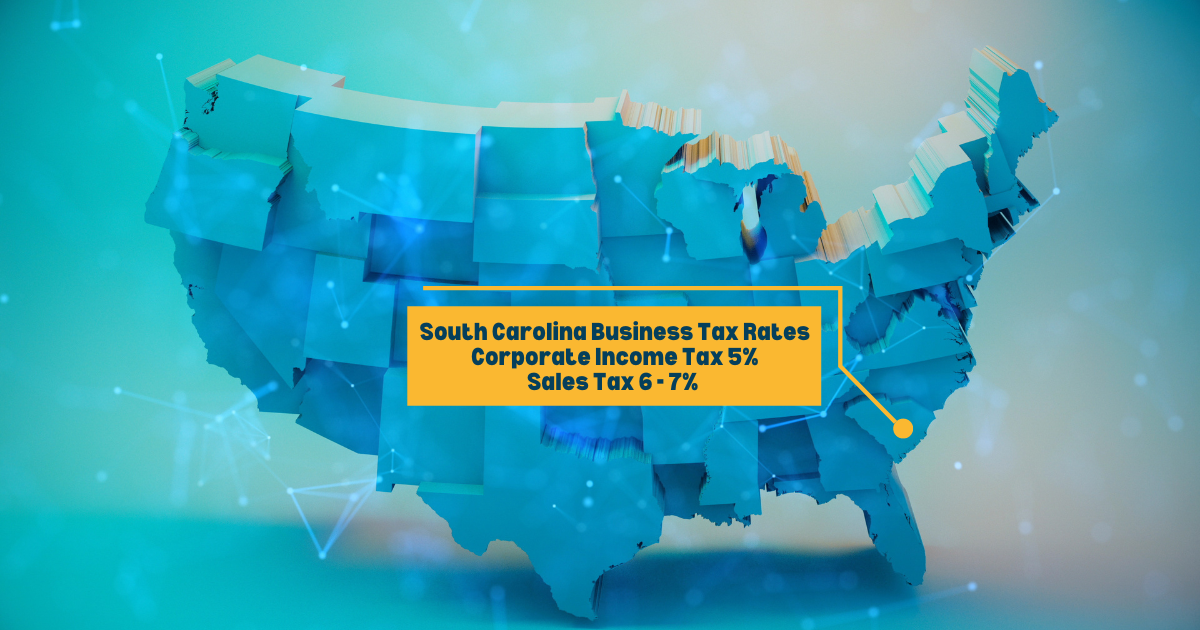
C Corporations in South Carolina face a Corporate Income Tax rate of 5% on their taxable income within the state. The computation of South Carolina taxable income originates from federal taxable income, incorporating specific modifications for the state, which are then subject to allocation and apportionment. In cases of multi-state corporations, there’s a direct allocation for nonbusiness-related income and gains/losses, followed by the application of an apportionment ratio to the remaining income post-allocation.
For corporations engaged in activities related to tangible personal property (excluding repair), such as manufacturing and selling, the apportionment ratio is based solely on sales. Conversely, other entities like financial businesses, services businesses, medical professionals, architects, installation and repair businesses, and contractors utilize a gross receipts apportionment ratio. Special apportionment methods are applicable for specific industries like railroads, telephone companies, pipeline companies, airlines, and shipping lines.
C Corporations are obligated to pay an annual License Fee, amounting to 0.1% of capital and paid-in surplus, plus a fixed $15. The License Fee cannot fall below $25 and must be settled by the original due date for filing the Income Tax return or extension request, applying to the tax year succeeding the Income Tax year. Both the Income Tax and License Fee details are documented on Form SC1120.
Is There a Corporate Minimum Tax in SC?
C Corporations are obligated to pay an annual License Fee, amounting to 0.1% of capital and paid-in surplus, plus a fixed $15. The License Fee cannot fall below $25 and must be settled by the original due date for filing the Income Tax return or extension request, applying to the tax year succeeding the Income Tax year. Both the Income Tax and License Fee details are documented on Form SC1120.
Establishing to do Business in South Carolina
Submitting a Corporate Tax return automatically enrolls your business with the South Carolina Department of Revenue (SCDOR). For first-time filers, remember to mark the Initial Return box on the SC1120 form. Once your Corporate Income Tax account is established with the SCDOR, you’ll receive a Corporate Registration Filing Requirements letter (SC1070) containing crucial details about your Corporate Income Tax filing obligations.
To prevent processing delays, it’s essential to include your Federal Employer Identification Number (FEIN) on all returns, payments, and correspondence sent to the SCDOR. Additionally, within 60 days of commencing business operations or utilizing capital in South Carolina, you must file a CL-1 (Initial Annual Report of Corporations) and remit the $25 initial Corporate License Fee. Ensure timely payment to the SCDOR if you haven’t already fulfilled this requirement with the South Carolina Secretary of State (SCSOS).
When is the South Carolina Corporate Income Tax Return Due?
With the exception of S Corporations and Tax-Exempt Organizations, all corporate taxable entities are required to submit annual filings on or before the 15th day of the fourth month following the conclusion of the taxable year, excluding the initial and/or final return.
How is State Income Tax Nexus Triggered?
In South Carolina, various activities can create income tax nexus, establishing a connection between a business and the state that subjects the business to income tax jurisdiction. Here are some examples of activities that do or do not create income tax nexus in South Carolina:
Activities That Create Nexus:
- Engaging in business activities within South Carolina.
- The out-of-state corporation provides non-de minimis consulting services within South Carolina.
- The out-of-state corporation, through a third party, offers warranty services for goods sold in South Carolina, subject to contractual control.
- Owning raw land in South Carolina.
- Storing inventory in a public warehouse in South Carolina for fewer than 30 days, excluding specific cases.
- Shipping in-process inventory to an unrelated party in South Carolina for processing, except under certain circumstances.
- Owning display racks, excluding sales or leasing of racks, and racks not used as vending machines.
- Possessing tooling, molds, dies, etc., situated at a manufacturing facility in South Carolina.
- Acting as a lessor, leasing real estate in South Carolina to an unrelated third party.
- Selling/licensing the right to use a patent or copyright to unrelated entities with locations in South Carolina.
- Leasing of mobile property, like rail cars, planes, and trailers, as a lessor. The lessee may utilize these assets in South Carolina, with the usage not being de minimis. Note: Referring to SC Private Letter Ruling #94-8, which determined that leasing airplanes landing in SC three times per year was not de minimis.
- Holding an ownership interest in an investment partnership or LLC taxed as a partnership, conducting operations in South Carolina. Note: Even if the income may not be subject to taxation in SC. See SC Commission Decision #92-58 and SC Private Letter
- Owning a general interest in a partnership engaged in business activities in South Carolina.
Activities That Generally Do Not Create Nexus:
- Making sales to South Carolina customers via an 800 telephone order number and advertises in the state.
- Being listed in local telephone books in South Carolina, with calls directed outside the state.
- Employing local phone numbers in South Carolina, forwarded to its out-of-state headquarters.
- Holding a bank account in South Carolina.
- Distribution of catalogs to residents in South Carolina.
- Owning or leasing automobiles allocated to salespersons.
Are There South Carolina Income Tax Credits Available?
South Carolina provides various corporate income tax credits to eligible businesses. Some common corporate income tax credits in South Carolina include:
Job Tax Credit:
This credit is available to businesses that create new jobs in the state.
Economic Impact Zone Credit:
Businesses located in designated Economic Impact Zones may qualify for this credit.
Research and Development Tax Credit:
Companies engaged in qualified research activities may be eligible for this credit.
Investment Tax Credit:
Businesses making qualified capital investments in South Carolina may qualify for this credit.
Renewable Energy Tax Credit:
Companies investing in renewable energy projects may be eligible for tax credits.
Textiles Communities Revitalization Credit:
This credit aims to encourage investment in revitalizing textile mill sites.
Abandoned Building Revitalization Credit:
Businesses investing in the redevelopment of abandoned buildings may qualify for this credit.
What is the South Carolina Sales Tax Rate?
In South Carolina, Sales Tax is levied on the sale of goods and specific services. The overall Sales & Use Tax rate across the state is six percent (6%). Additionally, counties have the option to apply an extra one percent (1%) in local sales tax, contingent on approval from the county’s voters.
How is Sales Tax Nexus Triggered in SC?
In South Carolina, if a remote seller has gross revenue surpassing $100,000 from sales of tangible personal property, electronically transferred products, and services delivered into the state in the previous or current calendar year, they establish economic nexus (substantial nexus) with South Carolina. In such cases, the remote seller is required to acquire a retail license and fulfill the responsibility of remitting South Carolina Sales and Use Tax.
What Transactions are Included or Excluded from Sales Tax?
In South Carolina, the Sales and Use Tax applies to the sale of goods and certain services. Here are some general guidelines on transactions that are included or excluded:
Included (Taxable):
- Sale of Goods: Tangible personal property is generally subject to sales tax. This includes items such as electronics, clothing, furniture, and other physical goods.
- Certain Services: Specific services are subject to sales tax. Examples include accommodations, telecommunications services, and certain digital products.
Excluded (Non-taxable):
- Food Sales: Generally, sales of unprepared food for home consumption are exempt from sales tax.
- Prescription Drugs: Sales of prescription drugs for human use are exempt.
- Sales to Government Entities: Sales to federal, state, and local government entities are often exempt.
- Sales for Resale: Sales of items for resale are typically exempt from sales tax.
- Medical Equipment: Some medical equipment and supplies may be exempt.
Are Services Taxed for Sales Tax?
Services in South Carolina are generally exempt from taxation, with specific exceptions, including:
- Admissions to places of amusement with an associated admission fee.
- Furnishing accommodations, subject to a 7% state tax rate.
- Dry cleaning and laundering services.
- Electricity.
- Communication services, encompassing telephone services (excluding those exempted under SC Code § 12-36-2120(11)), teleconferencing services, paging services, cable television services, satellite programming services, fax transmission services, email services, and electronic filing of tax returns by a non-preparer.
- Database access transmission services (online information services), excluding cooperative services’ computer database information assembled exclusively for its members’ use.
- Prepaid wireless calling arrangements (sale or recharge at retail) as defined in SC Code § 12-36-910(B)(5).
- 900/976 telephone service, subject to an 11% state tax rate, not the standard 6%.
Is SaaS Taxable for Sales Tax?
The South Carolina Department of Revenue deems Software as a Service (SaaS) as subject to taxation. This classification is based on the resemblance of an application service provider to taxable database access transmissions, as determined in a sales and use tax revenue ruling issued by the state.
Frequently Asked Questions (FAQs) – South Carolina Business Taxes
What is the Corporate Income Tax rate in South Carolina?
The Corporate Income Tax rate for C Corporations in South Carolina is 5% on their taxable income within the state.
How is income tax nexus triggered in South Carolina?
Various activities can create income tax nexus, including engaging in business activities within the state, providing non-de minimis services, owning land, and leasing real estate. However, certain activities like sales via an 800 number generally do not create nexus.
What are the common income tax credits available for businesses in South Carolina?
South Carolina provides various corporate income tax credits, including the Job Tax Credit, Economic Impact Zone Credit, Research and Development Tax Credit, Investment Tax Credit, Renewable Energy Tax Credit, Textiles Communities Revitalization Credit, and Abandoned Building Revitalization Credit.
What is the Sales Tax rate in South Carolina?
The Sales Tax rate in South Carolina is 6%, with the option for counties to impose an additional 1% local sales tax if approved by voters.
Are services subject to Sales Tax in South Carolina?
Generally, services are not taxable in South Carolina, with some exceptions such as admissions, accommodations, dry cleaning, electricity, and certain communication services. Software as a Service (SaaS) is also considered taxable based on state revenue rulings.

Leave a Reply